 Sokira
ADHD and the Mental Load: Remembering to Remember Everything
The mental load is carrying every task in your head before you even start them. Why it lands hardest on women with ADHD, and how saying it out loud helps.
The fairest criticism my wife ever leveled at our household was that she was the only person who knew what was in the refrigerator, the calendar, and the permission-slip pile all at once. I helped. I did tasks when I was asked. But I was not the one holding the whole map, and holding the map was the actual job.
Watching her, and watching my son lose things that were never written down anywhere, taught me the same lesson from two directions. A head is a terrible filing cabinet. And the person holding the file drawer shut all day has no hands left for starting anything.
Jack, Sokira’s founder
What the mental load actually is
The mental load is the work that happens before any work happens. It is noticing that the shampoo is nearly out. It is knowing the form is due Thursday, that Thursday is also the late shift, and that somebody therefore has to be asked on Tuesday. It is the running background process that tracks, anticipates, and remembers to remember.
None of it shows up as a completed task. That is the defining feature. You can spend an entire day carrying twenty things faithfully and arrive at bedtime with nothing to point at, which is why it is so easy for everyone, including the person doing it, to conclude that nothing happened.
The phrase came out of research on household labour, where it was used to describe why the split of chores can look even while the exhaustion does not. It is worth being honest that this conversation has always been a gendered one, and that the carrying still lands disproportionately on women. That is a pattern in how households and workplaces are organised, not a verdict on anybody’s partner. Most people carrying less are not refusing to help. They genuinely cannot see the load, because invisible is exactly what it is designed to be.
Why ADHD multiplies it
Now put that tracking system inside an ADHD brain and look at where it lives. It lives nowhere. It is held in working memory, which is the mental workspace where you keep things active while you are doing something else.
Dr. Russell Barkley has spent decades arguing that ADHD is best understood as a difficulty with executive function rather than with attention as such, and that working memory is one of the functions it taxes most. In his account, holding information active in mind while life continues around you is precisely the operation that costs more.
So the mental load asks the ADHD brain to do the one thing it finds most expensive, continuously, all day, in the background, with no output to show for it. Some research suggests this is why the strain can be so disproportionate to the visible workload. It is not that more is being done. It is that more is being held.
And the holding is not free. Every item kept alive in the head takes up room that would otherwise be available for beginning something. Which is how a person can be genuinely overwhelmed and genuinely unable to start, at the same moment, and be told they are doing neither.

A calm voice that helps you start. Free for the first week.
The unload
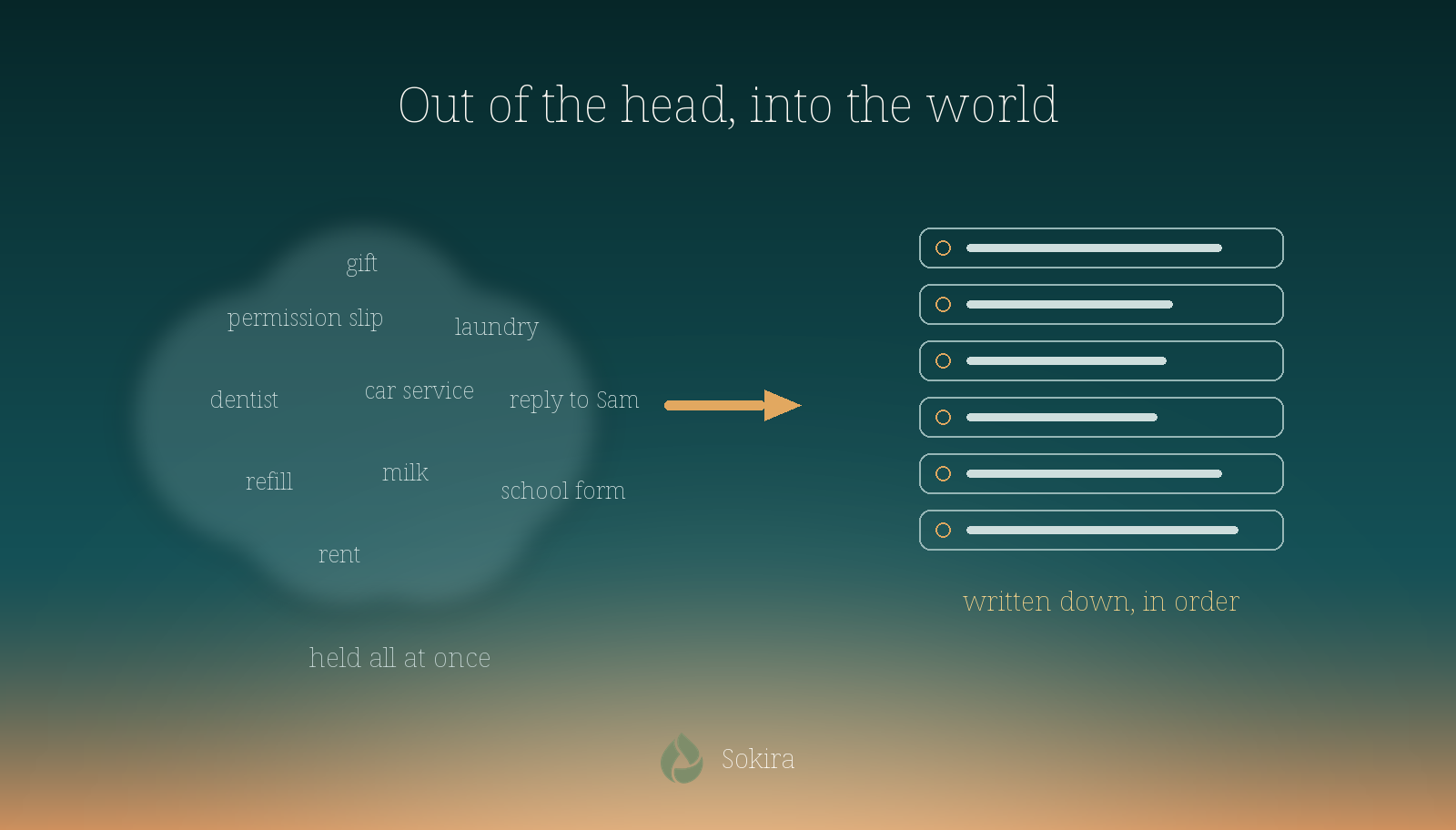
The move that helps is unglamorous and almost mechanical. Get the list out of the head and into the world, where it can sit without being carried.
Out loud works better than most people expect. Saying the whole untidy pile aloud, in whatever order it arrives, does something a neat written list does not: it does not require you to organise before you empty. You can say the dentist, the milk, the reply you have been avoiding, the thing you cannot quite name yet, and let them land outside your head first and get sorted second.
This is what the ADHD brain dump is for, and it is the practical companion to everything in this post. The goal is not a beautiful system. The goal is an empty drawer hand.
Then one thing, sized to start
Emptying is a relief, but a full list in front of you is still a full list. The next move is deliberately small: pick one item, and cut it down until beginning it is not a decision.
Not the project. Not the plan for the project. One small step, small enough to sound almost silly out loud, done with somebody present. Open the form. Find the envelope. Put the shampoo on the list you just made.
Presence at that moment matters more than motivation does. Most of the mental load never gets discharged because the person holding it never gets a clear runway to start anything, and starting alone from under a full head is the hardest version of the task.
The part about women
The mental load is one more reason ADHD stays unseen in women. From the outside, the household runs. The forms get in. Everyone is fed. The competence is real, and it is expensive, and none of it looks like a difficulty that anybody would think to name.
Why it goes unseen is largely this: effort that succeeds is invisible, and ADHD in women is often a story of enormous effort that succeeded just enough to avoid attention. The bill arrives later, quietly, usually as exhaustion.
If that is you, please take the obvious point. You are not lazy. You have been running a tracking system with no hardware, without being paid, thanked, or noticed for it. The load is real work. Putting it down out loud is not weakness or giving up. It is filing.
Sokira is somewhere to put it. You say what is in your head, it helps you cut one item down to a first move, and it stays with you while you start. Four calm voices, no scores, no streaks. First week free.
A calm voice that helps you start. Free for the first week.