 Sokira
The work before the work
Planning, remembering, deciding where to begin. Adults with ADHD describe doing invisible work before the visible work can start. Naming it changes it.

My son and I are not people who sit down and muscle through a PowerPoint. The work happens while I am driving, or at dinner, and from the outside it looks like nothing. Somebody says it is coming up, have you worked on it, can you send me something, and the honest answer is no, because the something is still in my head. We wait until the thing has formed into a plan or a story, then sit down and bang it out ugly, and polish it near the deadline, sometimes the night before. Same with research: I will ask an AI a pile of questions before I ever start, and that can read as procrastinating when it is the work itself. The visible part was always the short part.
Jack, Sokira’s founder
The 3pm mystery
Here is a familiar shape to a workday: by mid-afternoon you are properly tired, and there is almost nothing visible to show for it. No finished document, no sent proposal, no cleared list. Just tiredness, and the quiet question of what the day was actually spent on.
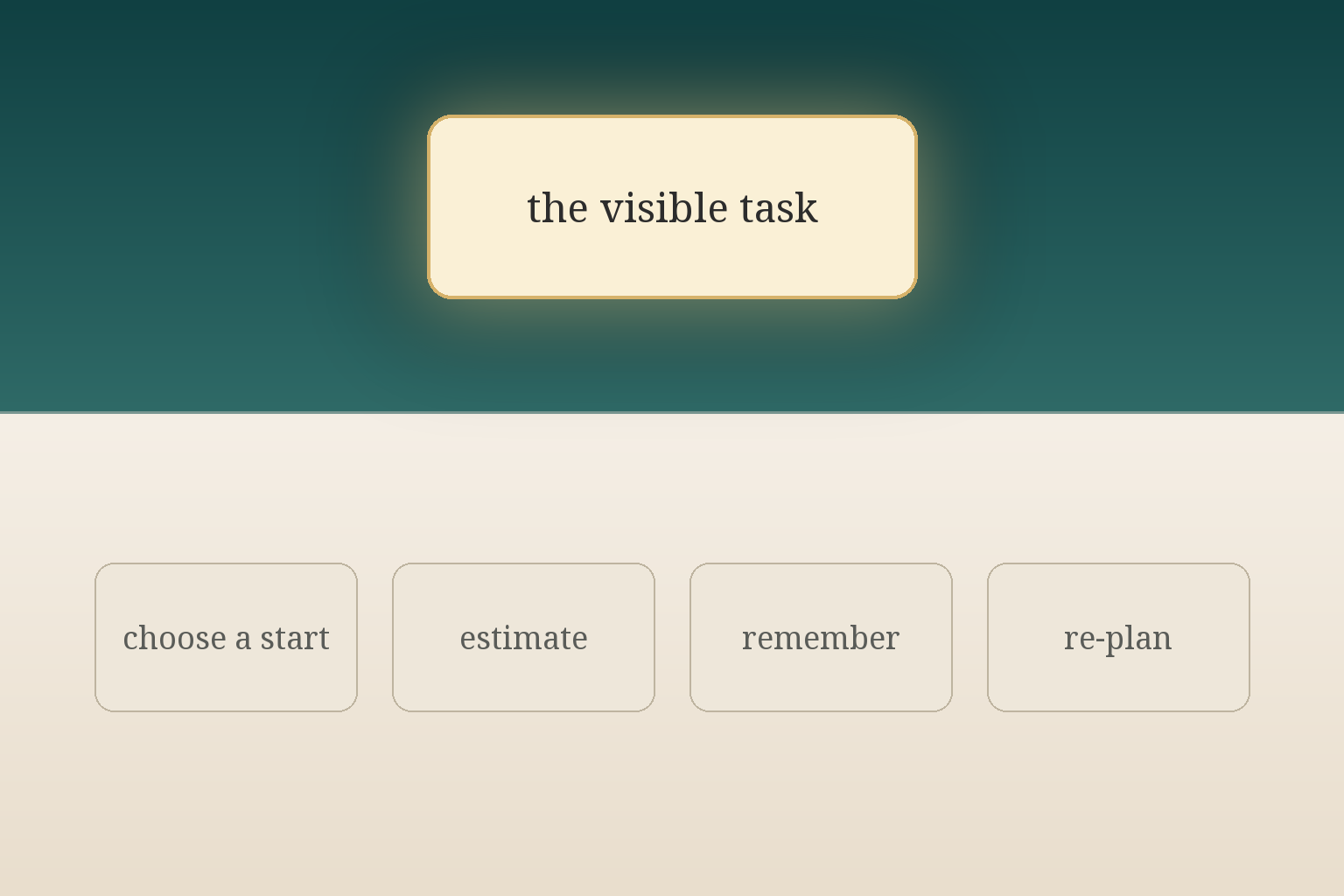
The answer is usually the work before the work. Deciding where to begin. Estimating how long the thing will take. Remembering what was promised, to whom, and by when. Re-planning when a meeting moves and the whole day slides sideways. None of it is the task, and all of it must happen before the task can. For many adults with ADHD the visible task is the easy part. The startup cost before it, invisible and uncounted, is where the energy goes. It is the same territory this series maps in task paralysis, seen from the other side: not why you stop, but what you spend before you start.
What researchers found in the conversations
A research team publishing in Frontiers in Psychology did something unusually patient: they read through years of workplace discussions in a large online ADHD community, thousands of conversations about working life, and mapped what adults with ADHD kept describing.
Three patterns stood out. Adults with ADHD described investing extra effort that was never asked of their colleagues, effort that happened before the visible work began. They described standard workplace habits and norms as built for a different kind of brain. And the moments things became manageable were the moments that labor moved out of one person’s head and into the environment, onto something visible, spoken, or shared.
A word of honesty about what this is: these are adults with ADHD describing their own working lives in their own community, gathered carefully by researchers. It is a map of experiences, not a trial of what works. But when the same shape keeps appearing across that many working lives, the shape itself is worth knowing.
Externalizing, practically
If the pre-work is the expensive part, the practical question is where it can live other than in your head. A few forms come up again and again.
The whole list said out loud once, so the head can finally put it down, which is the entire idea behind the ADHD brain dump. The first step named before the laptop even opens, so the starting moment arrives with a decision already made, which is help at the moment of starting. One anchor block with presence instead of a heroic empty-room day, which is body doubling at work. And the plan living somewhere eyes can find it, on paper, on a screen, said out loud, not only in memory.
The honest nuance
The same research carries a complication worth keeping: the same condition can help or hurt depending on how it is done. Structure helps until it turns rigid and becomes one more thing to maintain. Flexibility helps until it quietly removes every support. There is no one right setup, and anyone selling one is selling.
The reliable move is smaller and more personal. Make the invisible work visible first, then shape the setup around what breaks first for you. Not the ideal day. Your day, with its own particular first crack.

A calm voice that helps you start. Free for the first week.
The permission paragraph
If the pre-work exhausts you, hear this plainly: you are not doing less work than the people around you. You are doing more of it, unseen. Naming it is not an excuse. It is accounting.
And for some brains the unseen thinking is not overhead at all. It is where the real drafting happens. The plan forms away from the desk, on a drive, over dinner, in a pile of questions asked before anything looks like work, and then the visible draft pours out in one sitting. Calling that procrastination just because nobody can watch it is the mistake this post exists to correct.
Where Sokira sits
Sokira is a calm voice that carries the pre-work out loud with you: what comes first, how small it can start, and staying present while it does. The companion never asks what you have to show for the day, because it knows how much of the day never becomes visible. Each small kept start is also how self-trust gets rebuilt, one kept promise at a time.
A calm voice that helps you start. Free for the first week.