 Sokira
The Point of Performance: Why ADHD Help Works Best at the Moment of Starting
Advice fails and reminders fail because they arrive at the wrong time. Why ADHD support belongs at the point of performance, the exact moment of action.

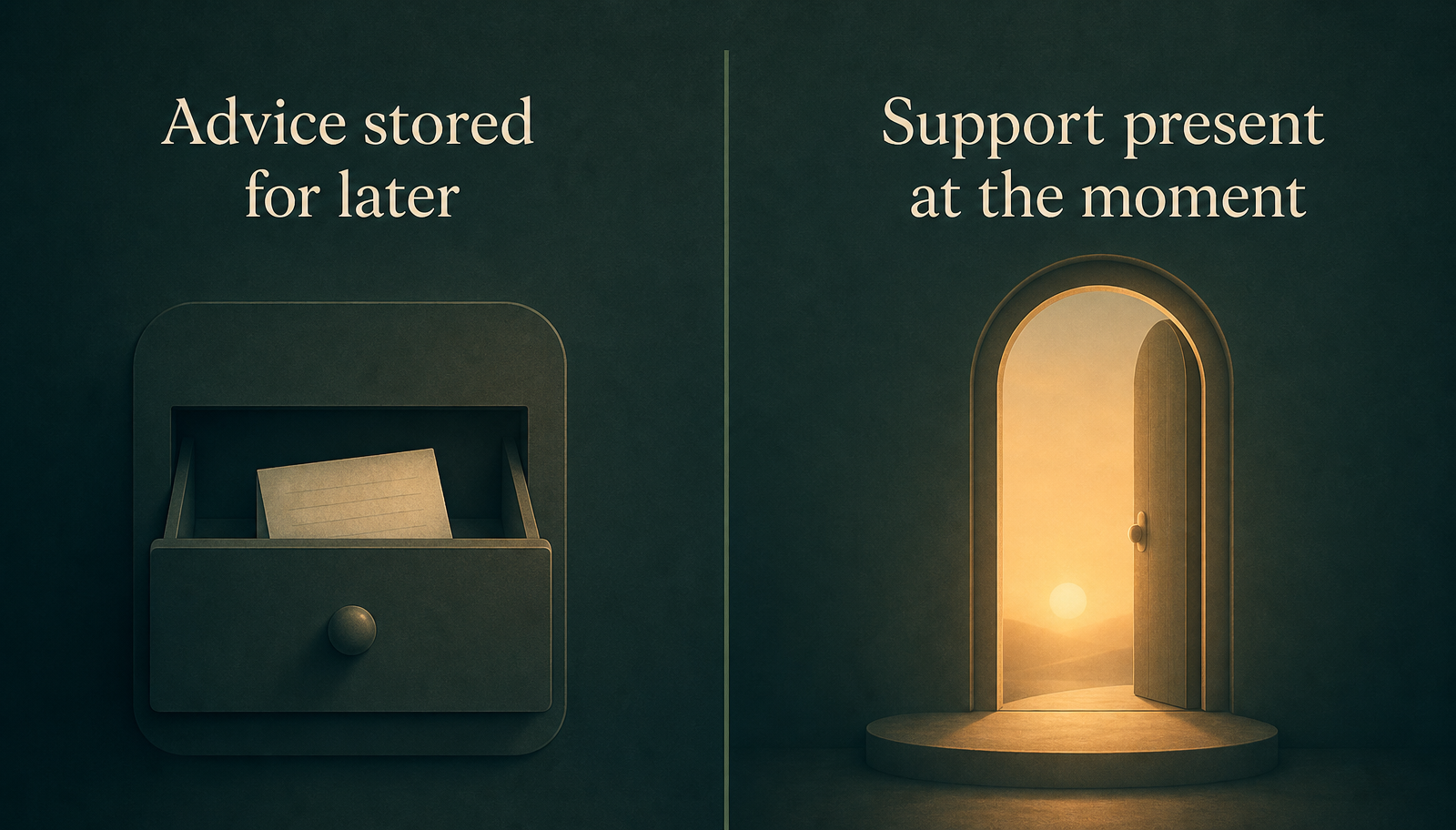
We had a drawer at home I called the graveyard of good intentions. Planners. Checklist pads. A timer cube. Two books with excellent underlined advice. None of it was wrong. All of it was somewhere else at 4pm when homework had to start.
The help my son needed was not better information the night before. It was a calm something at the kitchen table at the exact minute starting was hardest. Everything Sokira does came out of that drawer.
Jack, Sokira’s founder
You already know this pattern
The advice was right. The plan was right. You wrote the list on Sunday and it was a good list. And then Tuesday at two in the afternoon arrived, and the moment went sideways anyway. Not because you forgot the plan. You could recite the plan. You just could not get yourself into it.
That gap between knowing exactly what to do and doing it is the most exhausting part, because it looks from the outside like a choice. It is not a choice. It is a timing problem, and almost every piece of advice you have ever been given was delivered at the wrong time.
If you want the longer version of what happens inside that gap, we wrote about why starting is the hard part.
The idea: help belongs at the point of performance
Dr. Russell Barkley has long argued that ADHD support works best at the point of performance. That is his phrase for the place and the moment where the action actually has to happen. Out in the environment. At the kitchen table at 4pm. Not as knowledge tucked away the night before, and not as willpower saved up in advance.
Said in our own words: the gap is not knowing, it is summoning at the right instant. Most support systems assume the problem is a shortage of information, so they hand you more of it, earlier. But the information was never missing. What was missing was something present at the starting line.

A calm voice that helps you start. Free for the first week.
What it looks like in ordinary life
Once you see the idea, you see it everywhere, and most of it is delightfully unglamorous.
- The note on the door, not in the app. A sticky note at eye level where you actually leave the house beats a beautifully organised list you would have to remember to open.
- The gym bag in the car. Not in the hallway. Not in the plan. In the place where the decision gets made.
- A person present at the starting line. Someone quietly working nearby while you begin. That is what body doubling is, and it is point-of-performance support with a face.
- The step said out loud right then. Not planned, not written, spoken in the moment. There is more on saying the step out loud if you want it.
Notice what these have in common. None of them make you smarter or more disciplined. They just move the help closer to the minute it is needed. If you want a way to shrink that minute down to something you can actually do, that is the first step method.
Why this reframe takes the shame out
Here is the part that matters most. If help belongs at the moment, then failing to use last night’s plan is a logistics problem, not a character problem.
You did not fail the planner. The planner was in a drawer. The book was upstairs. The advice was in a video you watched three weeks ago. They were all in the wrong place at the wrong time, and no amount of wanting it more moves an object from a drawer to a kitchen table.
That drawer at our house was never proof that any of those tools were bad. Several of them were lovely. They were simply designed for a moment other than the one that was hard. Once you stop reading that as a personal verdict, the whole thing gets quieter, and you can start asking a much better question: what could be present at 4pm?
Where Sokira sits
Plainly: a voice companion is point-of-performance support you can carry. It is present exactly when starting happens, not the night before. You say what you are avoiding, it helps you break it down to one small first step, and it stays with you while you begin. Four calm voices to choose from. First week free.
No streaks, no scores, no verdict at the end of the day. Just something at the table at the minute it is hardest.
A calm voice that helps you start. Free for the first week.