 Sokira
Saying It Out Loud: Why Talking Through Tasks Helps ADHD
Talking a task through out loud can help an ADHD brain start. Here is the science of self-talk, and why voice beats a silent to-do list.
It felt silly the first time. I said, out loud, “okay, I’m going to open my laptop and write the first email,” almost narrating myself. I was not even talking to my son. I was just externalising the step so I could actually take it.
He looked up from his worksheet and said, “I’m going to do the first question.” It was not instruction from me. It was the invisible becoming visible, and him doing the same thing right after.
Now we do it casually. “I’m just going to put on my shoes.” “I’m opening the doc.” It lowers the barrier between thinking and doing in a way that a checklist on a screen never has for either of us.
Jack, Sokira’s founder
The everyday experience
You have probably done this without a name for it. You stand up, say “right, I’m making the coffee,” and then you actually make the coffee. Or you mutter “keys, wallet, phone” on your way to the door and the leaving-the-house part suddenly works. The task was fully formed in your head a minute ago and still would not move. The moment you said the next step out loud, it started.
People with ADHD often describe this effect more strongly than others do, and often stumble onto it by accident. It looks like talking to yourself. It feels a little strange. And it is one of the more reliable low-effort tools for beginning a task you have been circling for an hour.
The science, carefully
Research suggests why. In Dr. Russell Barkley’s leading theoretical framework of ADHD, and he is among the most-cited researchers in the field, self-talk is not a habit or a quirk. It is one of the executive functions. It is a mental tool the brain uses to hold a plan, sequence steps, and steer behaviour.
The important detail is how that tool develops. Young children talk to themselves out loud while they play and problem-solve. Over years, that speech gradually goes quiet and internalises, becoming the private, silent thinking most adults do when they plan. Barkley’s framework describes ADHD as, in part, a slower or partial internalisation of that self-talk. The tool is still there. It often just still works best out loud.
To be honest about the leap: Barkley did not say “so talk to an app.” That is our framing, not his. His framework is about self-talk as an executive function. What Sokira does is scaffold that. We would not claim it trains or restores executive function, and we would not put that claim in Barkley’s mouth.
Why voice beats a silent to-do list for starting
A to-do list is a storage tool. It holds the tasks so you do not have to. That is genuinely useful for remembering, and it is almost useless for starting. Looking at “write report” on a screen is closer to seeing a mountain than to taking a step.
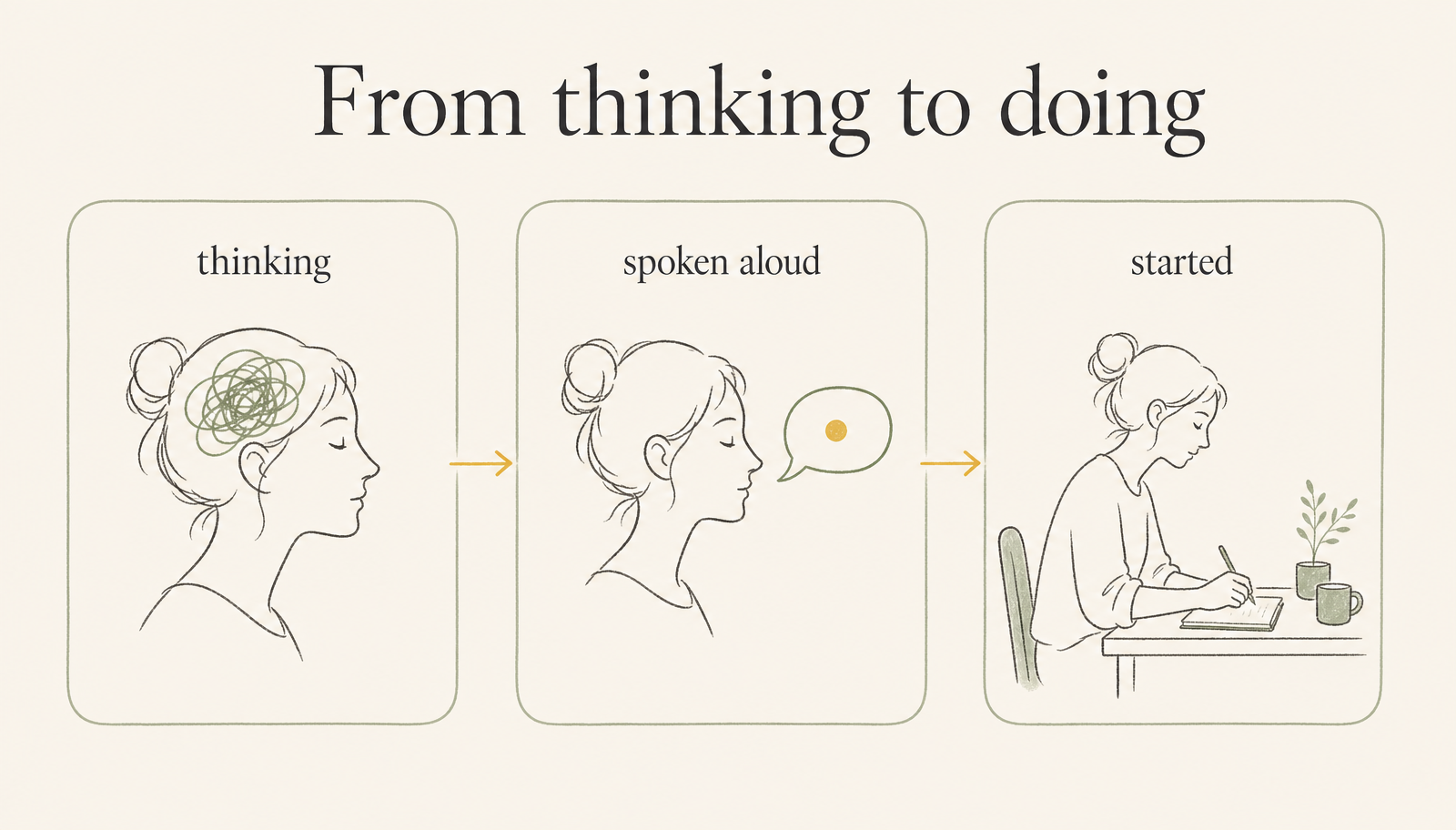
Saying the next step out loud does something different. It moves the task from thinking into doing by making it audible, present, and specific. “Open the doc” is not a life goal. It is a small verbal commitment, in this room, right now, that your body can follow.
A list stores the task. Your voice starts it.

A calm voice that helps you start. Free for the first week.
How to use your own voice today
You do not need an app to try this. You have the tool already. A few ways in:
- Name the next step, out loud, before you take it. Not the whole task. The very next physical move. “I’m going to open the drawer.” “I’m going to sit down at the desk.”
- Talk yourself through the messy first minute. “Okay, the folder is here. This one is the one I want. I’m reading the first line.” It sounds strange on the page and feels normal in practice.
- Use a voice memo as a body double. Open your phone’s voice recorder, say the plan into it in one take, and start. You do not have to listen back. The act of saying it is most of the effect.
- Narrate transitions, not just tasks. Leaving the house, closing the laptop, switching between two things. Those in-between moments are often where the day silently gets lost.
Where Sokira fits
Sometimes there is no one in the room and talking to yourself into the ceiling is not quite enough. That is the honest gap Sokira is built for. It is a voice you can talk to that stays with you while you begin, and helps you name one small step out loud until it is small enough to actually take. Four calm voices to choose from. First week free.
If you want the wider picture, we have written more on why a present companion helps ADHD brains start and the first-step method.
A calm voice that helps you start. Free for the first week.