 Sokira
Body Doubling for ADHD: What It Is & Why It Helps
Body doubling means starting a task with someone present. Here is why it helps ADHD brains begin, and how a voice companion does the same.

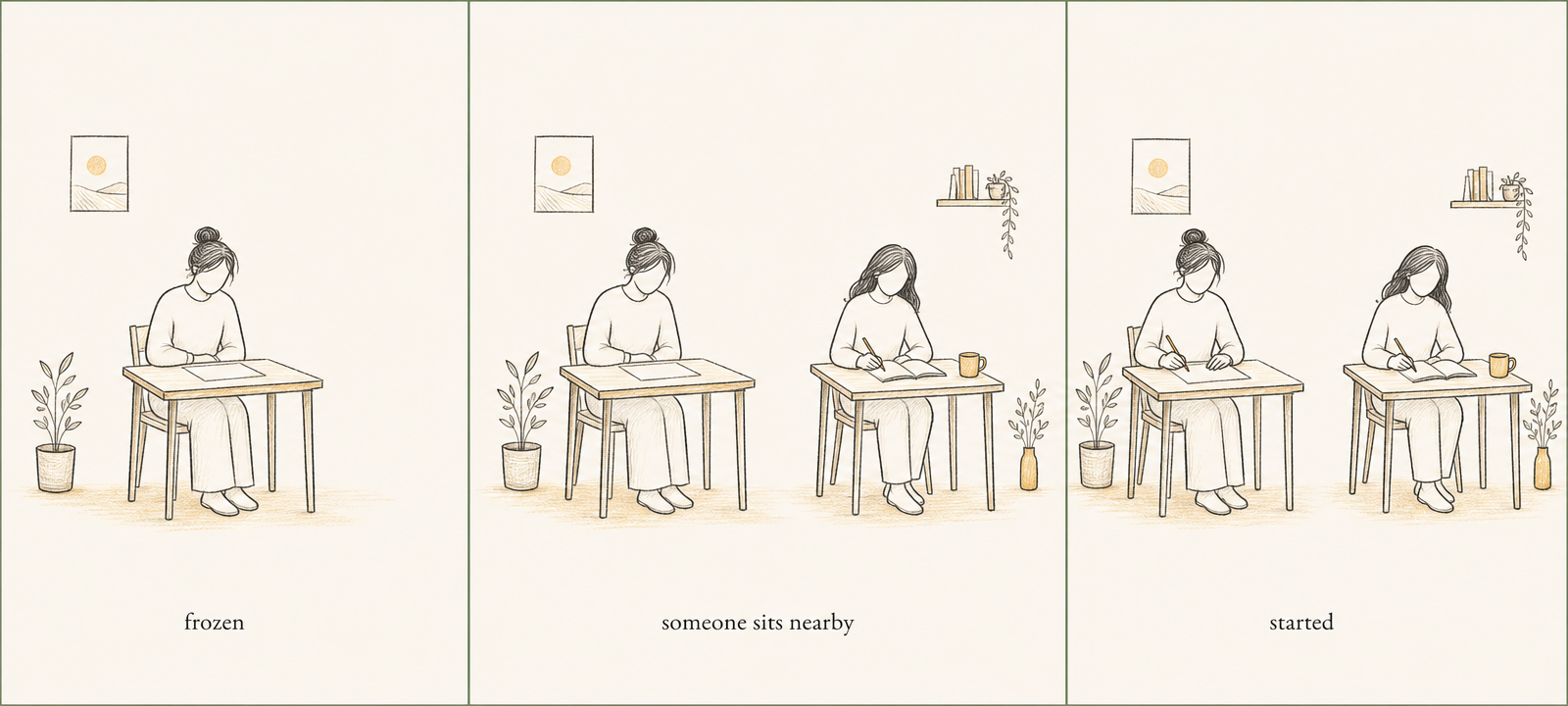
My son froze in front of a blank worksheet for almost twenty minutes. Not distracted. Frozen. I sat across from him at the kitchen table, opened my laptop, and said, “I’ve got some emails to knock out.” Within a couple of minutes he picked up his pencil.
What hit me is that I did not help. I just existed nearby, doing something parallel, and that unlocked him.
A few weeks later I tried to be more useful. I sat with him more intentionally, watched, asked “how’s it going” every couple of minutes, corrected a small thing here and there. He shut down almost instantly. That was the failure I learned from. Body doubling is not accountability. The moment it starts to feel like evaluation, it stops working.
Jack, Sokira’s founder
What body doubling is
Body doubling is a calm presence while you begin something hard. Not supervision. Not accountability pressure. Not a check-in system. Just another person quietly there, doing their own thing, while you do yours. The room stops feeling empty and the task stops feeling bottomless.
Why it works for ADHD brains
The hardest part of a task, for a lot of ADHD brains, is not finishing it. It is starting. The pencil sitting on the desk can feel heavier than the whole worksheet.
Some research suggests why. Dr. Nora Volkow, director of the U.S. National Institute on Drug Abuse, led imaging work that mapped differences in the brain’s dopamine reward pathway in ADHD. The practical takeaway is that starting is hard because the reward signal for a distant, abstract outcome is weaker, not because someone is lazy. It is a difference in how the brain registers “this is worth doing right now,” not a character flaw.
A present companion supplies a “now” signal that a future reward cannot. The task becomes something happening in this room, in this moment, in company. That is often enough to cross the gap between thinking about starting and starting.

A calm voice that helps you start. Free for the first week.
Presence, plus saying it out loud
There is a second piece that quietly matters: talking through the task. In Dr. Russell Barkley’s leading framework of ADHD, and he is among the most-cited ADHD researchers, self-talk is itself an executive function. It develops by being spoken out loud, in company, before it moves inward and becomes silent planning.
That is a useful lens for why body doubling often works better when you narrate a little. “Okay, I’m opening the folder. I’m going to read the first question.” The words are not for the person across from you. They are how a plan takes shape.
To be honest about the leap: Barkley did not say “so talk to an app.” That is our framing, not his. We would not claim Sokira restores or trains executive function. The honest verb is scaffolds. A voice companion gives self-talk somewhere to land, out loud, when there is no one else in the room.
Ways to body double
Presence can look like a lot of different things:
- A friend on a silent video call while you both work.
- A coffee shop, a library, a co-working room.
- A “clean with me” or “study with me” video playing on your second screen.
- A voice companion you talk a task through with.
If you want to go deeper on any of these, we have written more on what body doubling actually is, whether it really works, body doubling for cleaning, and talking a task through out loud.
More in this series: Body Doubling at Work: Staying Started Through the Workday, Virtual Body Doubling: Does Presence Work Through a Screen?, The Point of Performance: Why ADHD Help Works Best at the Moment of Starting, and Body Doubling for Studying: Starting the Reading You Keep Avoiding.
When presence is not enough, shrink the step
Sometimes a person is right there and you still cannot start. That is usually a sign that the step you have in your head is too big. The fix is not more willpower. It is a smaller first move.
“If I'm having trouble getting started, then the first step is too big.”

“Open the doc” is a step. “Write the first paragraph” is a project. Body doubling helps most when the thing you are about to do is genuinely small enough to begin.
Where a voice companion fits
A body double at three in the morning is a hard thing to arrange. So is one on a Tuesday afternoon when your friends are at work and the coffee shop is loud. The honest edge of a voice companion is that it is there when no session and no person is, and there is no one to perform for. You can say the messy version of the plan out loud, shrink the step, and begin.
That is what Sokira is built to be. A calm presence you can talk to while you start.
A calm voice that helps you start. Free for the first week.