 Sokira
Does Body Doubling Actually Work? An Honest Look
Does body doubling really help ADHD focus, or is it hype? An honest look at what researchers say, and how to test it on yourself.

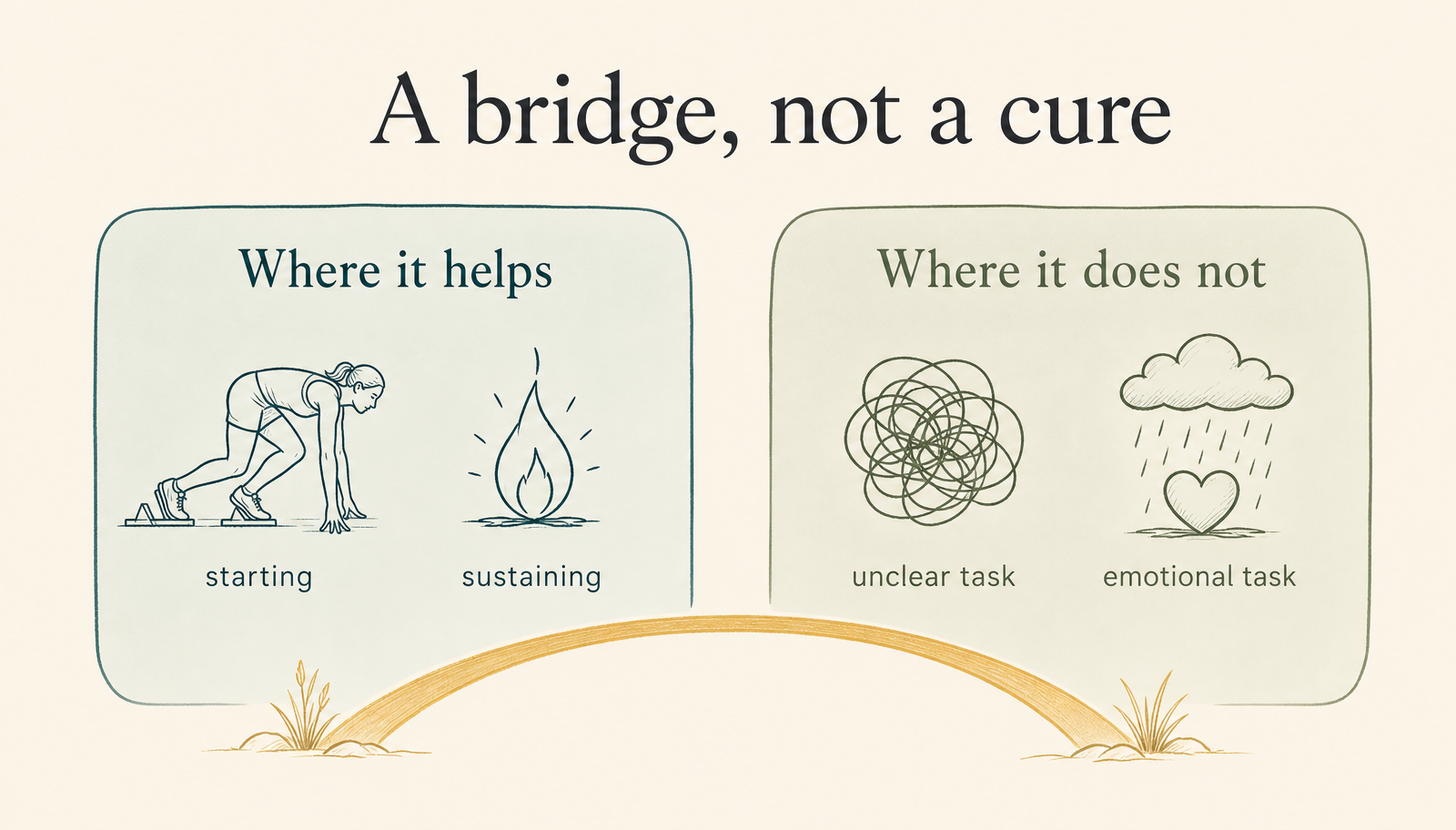
My honest read, from watching my son, is that body doubling works best at the starting line. When the problem is initiation, when the task is sitting there and he cannot cross the gap into it, presence helps almost every time. It also helps with sustained effort on medium-difficulty work. Someone quietly nearby seems to keep the thread from slipping.
Where it does not work is just as important. When the task itself is unclear, or emotionally loaded, no amount of presence fixes that. I also thought it would help his sense of time. It did not. He would still surface hours later, surprised.
So it is not a cure. It is a bridge. It gets you moving. It does not replace structure, clarity, or emotional regulation.
Jack, Sokira’s founder
The honest headline
Body doubling is widely used and widely reported to help. People with ADHD have described the effect for a long time, coaches build their practice around it, and a large online culture of quiet co-working videos has grown up around the same idea. The formal research on body doubling specifically is still emerging. Both of those things are true, and we would rather say so than overclaim.
What we do understand about why it might help
Two leading frameworks in ADHD research offer a useful way to think about why presence might change what a task feels like.
The first is the work of Dr. Nora Volkow, director of the U.S. National Institute on Drug Abuse, whose imaging research maps differences in the brain’s dopamine reward pathway in ADHD. Research suggests that a distant, abstract outcome sends a weaker “this is worth doing right now” signal in ADHD brains. A present companion adds a small, immediate now signal that a future reward cannot. That is a framework, not a proof, and Volkow’s work is about reward pathways in general, not body doubling in particular.
The second is Dr. Russell Barkley’s account of self-talk as an executive function. In his framework, planning starts as speech, out loud, in company, before it moves inward and becomes silent thought. Research suggests that having someone quietly present is part of what makes that spoken planning natural in the first place. Again, it is a lens, not a claim that Barkley studied body doubling.
Why it fits ADHD specifically
Body doubling is not something everyone needs. A lot of people begin tasks without much friction and never think about it. Dr. Thomas Brown, of the Yale Clinic for Attention and Related Disorders, has described a two-condition focus pattern he sees repeatedly in ADHD: the brain reliably sustains attention under genuine interest or real urgency, and most everyday tasks are neither. That gap is where body doubling has something to offer. Presence turns an abstract task into something happening in this room, in company, which is closer to the conditions the ADHD brain actually engages under.
How to test it on yourself this week
The honest way to know whether body doubling helps you, specifically, is a small experiment. You do not need a coach, a subscription, or a new app to run it.
- Pick one task you have been putting off. Keep it small enough that you could plausibly start it in the next ten minutes.
- Try it alone first. Sit down, notice honestly how it feels to begin, and give it a fair few minutes.
- The next day, try the same kind of task with a body double. A friend on a silent video call, a coffee shop, a quiet co-working room, or a “work with me” video on a second screen. Anything where another person is present without evaluating you.
- Afterwards, ask yourself two questions. Did I start sooner? Did I stay with it longer? That is the whole test.
If the answer to both is yes, you have found a real tool. If the answer is no, that is useful too. It means the sticking point is probably somewhere else, and presence alone is not the lever.
Where a voice companion fits
A body double at three in the morning, or on a Tuesday afternoon when your friends are at work, is hard to arrange. That is the honest gap a voice companion tries to fill. Sokira is a calm voice you can talk your task through with, out loud, and shrink the first step down to something you can actually begin. It is not a therapist, and it does not replace one. It is a bridge for the moment you are trying to start. The first week is free.
If you want the underlying idea in one piece, we have written more on how body doubling works.

A calm voice that helps you start. Free for the first week.