 Sokira
Virtual Body Doubling: Does Presence Work Through a Screen?
You do not need someone in the room. How virtual body doubling works for ADHD, from video calls to voice companions, and how to pick your format.
The strangest discovery from my kitchen-table years was that presence did not need a body. A muted call, camera off, worked. Me moving around in the next room worked.
Once I noticed that, the question that eventually became Sokira asked itself: if presence is mostly a signal, how small can the signal get and still work? For my son the answer was surprisingly small. A voice was enough.
Jack, Sokira’s founder
The claim, stated honestly
A lot of people report the same thing: a screen or a voice supplies the same starting help that a person in the room does. Not a watered-down version of it, the same thing. The task that would not begin in silence begins when something is present, even when that something is a small window in the corner of a laptop.
It is worth saying plainly that formal research on the virtual formats is young. There is thoughtful work on why environmental support helps ADHD brains act, and there are a great many people describing what happens for them, and there is not yet a large pile of trials comparing a video call to a kitchen chair. So take this as careful description rather than settled science. If you want the longer version of that honesty, we wrote about whether it works at all.
The formats
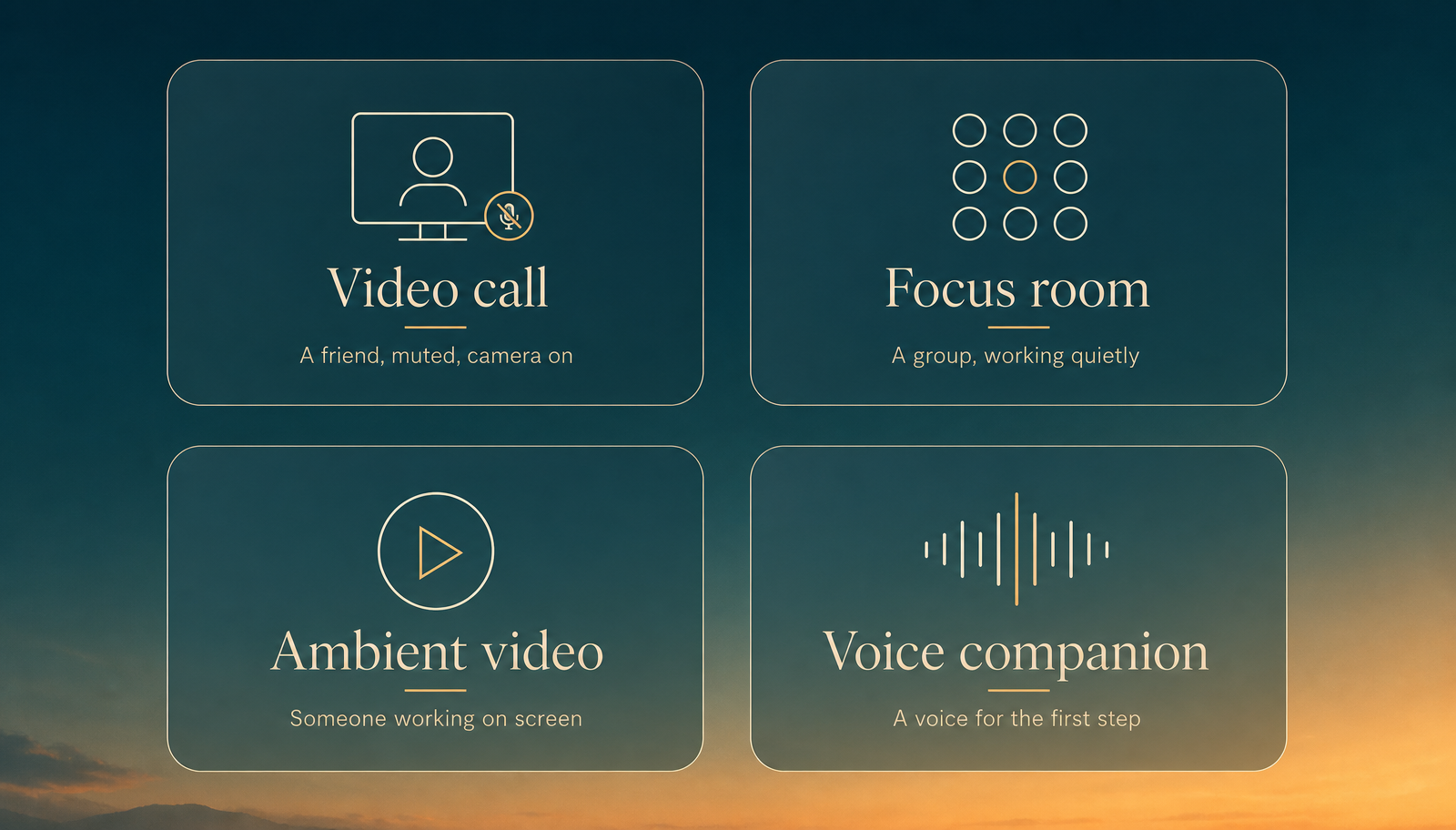
Virtual body doubling is not one thing. These are the shapes it usually takes, described plainly, because what suits one person is often unbearable for the next.
A friend on a video call. You both show up, say what you are doing, then work with the call open and the talking finished. It feels like sitting in the same room, which is exactly the point. What it asks of you is a person who is free at the same time, and a small amount of scheduling.
Group focus rooms. A shared session with strangers, usually with a start time and a quiet stretch in the middle. It feels slightly formal, a bit like a library, and the anonymity suits people who find a friend’s attention too warm. What it asks is that you turn up at a set hour.
Ambient work-with-me videos. Someone working on a screen while you work. Nobody can see you, nothing is expected, and the presence is entirely one-way. It feels like company without exposure. What it asks is almost nothing, which is also why it can fade into background noise.
Voice companions. A voice that talks with you at the start and stays through the first stretch. No camera, no scheduling, no other people. It feels closer to someone in the next room than to a meeting. What it asks is that you say the task out loud.
Why a signal can stand in for a person
Dr. Nora Volkow’s research on the reward pathways in ADHD helps explain the shape of the problem. A distant intention, however sensible, tends not to move the brain the way a present cue does. Something happening now carries weight that something scheduled for later simply does not, which is why a task can be both genuinely important and completely unstartable. A person on a screen is a now.
Dr. Russell Barkley has made a related argument about self-talk: the inner voice that guides action is, in his account, something that began outside us and moved inward, and when it is not carrying the load well it can be put back outside. A companion saying the step aloud is that voice returned to the room, which is the same reason saying the step out loud helps at all.
Barkley has described ADHD as like having “a race-car engine with bicycle brakes.”
The line is useful here because it explains why external supports matter at all. The trouble is not a shortage of engine. It is the braking and steering that hold action together in the moment, and supports that sit in the moment do work that advice cannot.
How to choose your format
Rather than looking for the format everyone recommends, notice what breaks first for you.
- If silence is the problem, ambient presence is often enough. You need the room to stop being empty, not to be answerable to anyone.
- If accountability is the problem, a scheduled session with another human tends to hold better, because a set time with someone else in it is harder to quietly skip.
- If loneliness is the problem, a friend on a call does something the other formats do not, and the work is almost a side effect.
- If the first step itself is the problem, you need something that will help you name it, not just witness you failing to begin. That is a conversation, however short.
None of these is a ranking. People move between them by season, by task, and by how much social energy they have that week, and that is a reasonable way to live. The underlying idea stays the same across all of them, which is what body doubling is and, more broadly, why presence helps ADHD brains start.
The voice case, briefly
A companion that talks the first step out loud with you is the smallest possible double. No camera, no other person’s schedule, no being seen. Sokira is a voice you can start with: you say what the task is, it helps you cut it to a first move, and it stays while you begin. Four calm voices, no scores, no streaks. First week free.
It is not better than a friend on a call, and we would not pretend otherwise. It is smaller, and available, and for a lot of days that is the difference between starting and not.

A calm voice that helps you start. Free for the first week.