 Sokira
What Is Body Doubling? The ADHD Focus Trick Explained
Body doubling is doing a task alongside another person so you can actually start. Here is what it is, why it works, and how to try it today.

Before I had a term for it, we just called it “working together.” Sometimes that meant me folding laundry while my son did homework at the kitchen table.
The least obvious thing that worked was ambient presence. I would be on a muted Zoom call in the same room, camera off, and he would start tasks more reliably than when I was actively helping. Sometimes just hearing movement was enough. Me making coffee. Opening a drawer. It was like his brain needed proof the world was in motion to join it.
Jack, Sokira’s founder
The plain definition
Body doubling is working near someone, in person or virtually, so their presence helps you begin. That is the whole trick. Two people in the same room or on the same call, each doing their own thing, at the same time.
Where the term comes from, and what it is not
The phrase comes out of the ADHD coaching world, where people noticed that clients could start tasks in a coach’s quiet company that they could not start alone. It has since traveled far beyond coaching. Study rooms. “Work with me” livestreams. Silent video calls between friends.
It is worth saying clearly what body doubling is not. It is not accountability. It is not being watched. It is not scoring, checking in on progress, or reporting back on what you did. The other person is not evaluating you. The moment it starts to feel like evaluation, the effect quietly falls away.
Why the presence helps
Some research suggests why. Dr. Thomas Brown, of the Yale Clinic for Attention and Related Disorders, has described a two-condition focus pattern he sees again and again in ADHD: the brain reliably sustains attention under genuine interest or real urgency, and most everyday tasks are neither. That is the gap most of us are stuck in on a Tuesday afternoon. Body doubling gently supplies a bridge across it. Another person’s quiet presence turns an abstract task into something happening now, in company.
One of Dr. Brown’s patients put the daily experience of that gap this way:
“My mind's a great sprinter but a lousy distance runner.”
For more on why a present companion helps ADHD brains start, we go deeper in the hub piece.
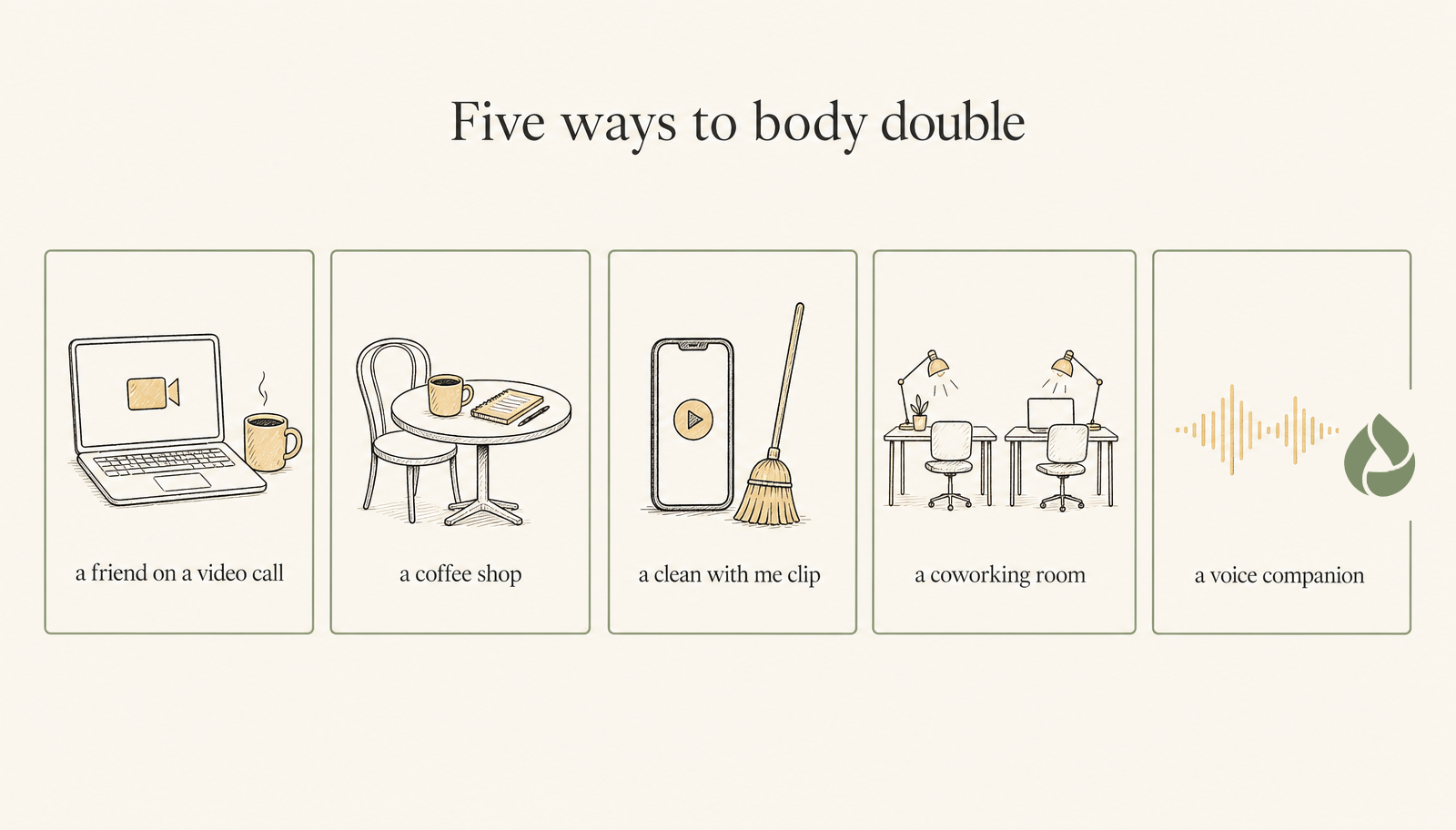
Five ways to try it today
None of these need to be formal. Pick the one you can start with in the next hour.
- A friend on a video call. Both cameras on or both off. Say hello, name your one task, then work in comfortable silence.
- A coffee shop. The ambient hum of other people doing their own thing is often enough.
- A “clean with me” clip. Put a calm video on a second screen and do your version of the task alongside.
- A coworking room. A library, a quiet cafe, a coworking space, even a friend’s living room.
- A voice companion. When no session and no person is around, Sokira is a calm voice you can talk your task through with, out loud, and shrink the first step down to something you can actually begin. Free for the first week.

A calm voice that helps you start. Free for the first week.