 Sokira
Body Doubling for Studying: Starting the Reading You Keep Avoiding
For adult students and professionals studying for exams: how body doubling turns an unstartable study session into a started one.
I got my BBA the ordinary way, but twenty years later I studied for a professional certification at my own kitchen table and rediscovered the old wall: the book open, the highlighter ready, and my brain filing an objection to every first paragraph.
What got me through was embarrassingly simple. My wife read her own book at the same table. She never once asked how it was going. The reading started because the room had company in it.
Jack, Sokira’s founder
The unstartable study session
You cleared the evening. The desk is tidy, which took a suspicious amount of care. The material is open in a tab, and the tab has been open for so long that it has stopped registering as a thing you are supposed to do. At some point you look up and an hour is gone, and you could not honestly say where it went.
Nothing dramatic happened. You did not decide to skip it. That is the part that is hard to explain to people who have never met this wall: there was no moment of refusal, just an absence of beginning. The intention was real the whole time, and it never converted into a page being read.
Why studying is the perfect storm
Studying tends to combine everything that makes starting hard. The deadline is weeks away, so there is no pressure in the room right now. The material is often genuinely uninteresting, or interesting in a slow way that only pays off later. And unlike a meeting or a shift, nobody is expecting you at eight o’clock, so nothing external marks the moment as begun.
Dr. Thomas Brown described a pattern many adults recognise: attention shows up reliably when a task is genuinely interesting or genuinely urgent, and struggles when it is neither. Studying is often neither, right up until the week before the exam, when urgency finally arrives and does the work that willpower could not. That is not a plan anybody should be proud of, and it is also not a character flaw. It is what happens when the only reliable trigger is panic.
“My mind's a great sprinter but a lousy distance runner.”
The useful move is to stop waiting for the urgency and add something else to the room instead. Presence is the easiest thing to add, and what body doubling is is really just that, done on purpose.
Setups that work for study
- A same-table partner doing their own work. A partner, a housemate, a friend with their own reading. They are not checking on you and they are not helping. They are simply there, and the table stops being empty.
- A silent corner of a library. A room full of other adults quietly working is a body double at scale, and it asks nothing of you socially. The commute is often the price of entry, and it is often worth it.
- A focus room online. A scheduled session with other people working in silence. Useful when the hard part is that nothing marks the start of the evening.
- A voice companion to open the session. Something that helps you say what you are about to read, then stays through the first stretch. The opening ten minutes are usually the whole problem.
The session recipe
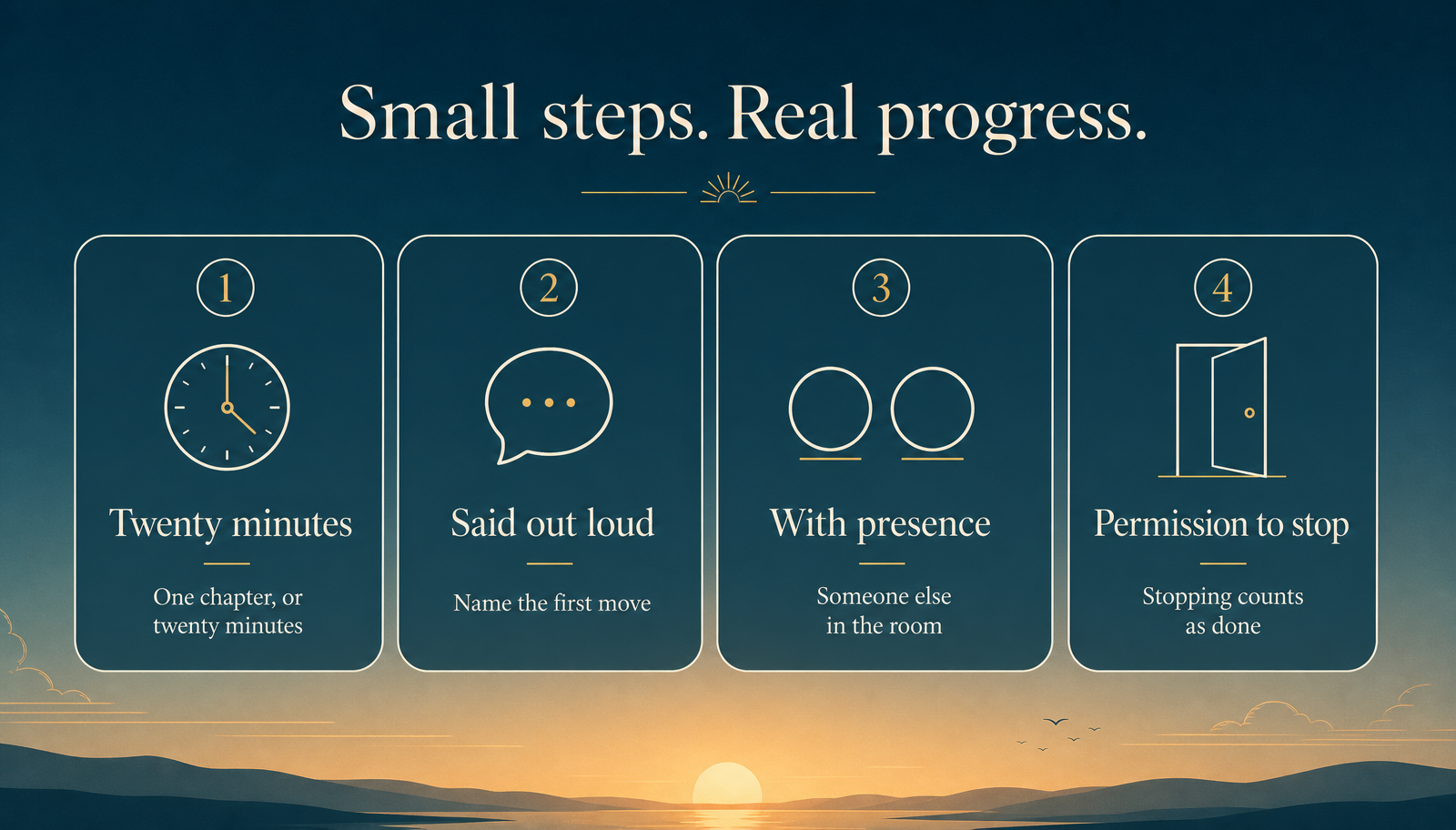
One chapter, or twenty minutes, whichever comes first. Say it out loud before you begin, because a spoken step is a different thing from a vague one. Have presence in the room in whatever form you can get. Then, and this is the part people skip, give yourself permission to stop when the twenty minutes are up.
The permission is not a softener attached to the end of the plan. It is the mechanism. A session you are allowed to leave is a session you are willing to enter, and most study evenings die at the door rather than in the middle. If you stop at twenty minutes, you studied. If you keep going because the material finally has hold of you, that is a bonus and not the target.
This deliberately rules out the all-night version. Long panic sessions the week before an exam are not a system, they are what happens when there was no system, and they are miserable to repeat. Short started sessions, spread out, ask far less of you.
The same help, in other rooms
If this sounds familiar from your job, it is the same mechanism wearing different clothes, and the same help at work applies to the report you have been circling for three days. The broader picture of why presence helps ADHD brains start covers why one quiet person in the room does more than another rearranged study plan.
Sokira is a voice you can open a study block with: you say what you are about to read, it helps you cut it down to a first move, and it stays with you while you begin. Four calm voices, no scores, no streaks. First week free.

A calm voice that helps you start. Free for the first week.