 Sokira
One Small Step: The ADHD First-Step Method
If you can't start, the first step is too big. Here is the one-small-step method for ADHD, backed by a named researcher, and how to use it now.
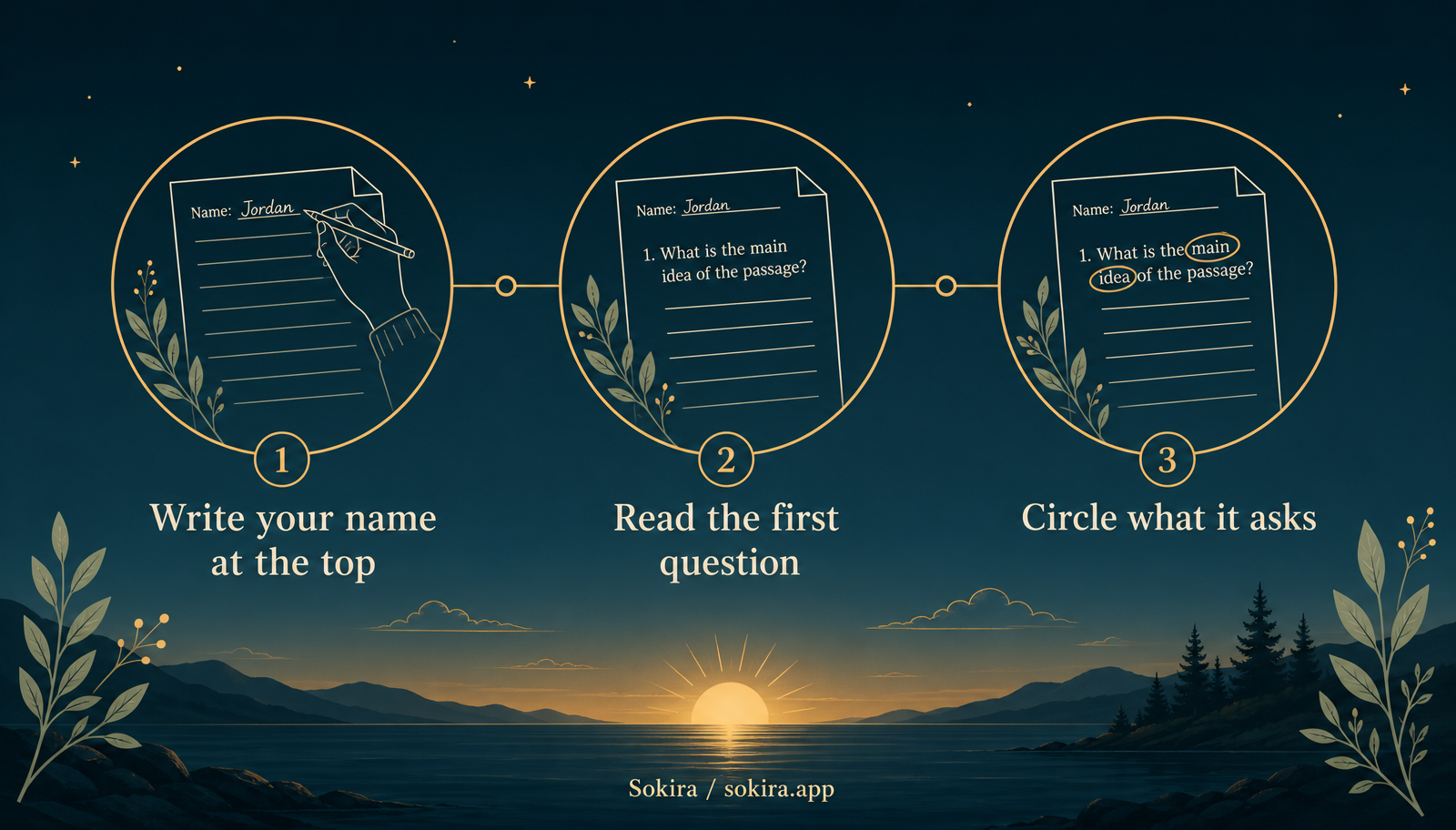
The homework night that changed everything looked, from the outside, like nothing at all. My son was sitting at the kitchen table with a worksheet in front of him and a pencil in his hand, not moving. The assignment was not unusually hard. He understood the subject. But the worksheet sat there like a wall.
We had already tried “start your homework.” We had tried “just do the first problem.” Some nights those worked. That night they did not. So I made the step smaller, and then smaller again, until it sounded almost silly. “Just write your name at the top.” That was all. He wrote his name. The page was no longer blank. Then “just read the first question.” Then “circle what it is asking.” Each step was so small it felt like a trick. But momentum took over, and the worksheet got done.
Jack, Sokira’s founder
The one line that changes it
There is a sentence I keep coming back to. It is the simplest diagnostic tool I know for task paralysis, and it comes from a researcher who has spent years studying exactly this.
“If I'm having trouble getting started, then the first step is too big.”
Read it as strategy, not treatment. The trouble starting is not a failure of will. It is information. It is the task itself telling you that the entry point you are holding is too large for the brain you have right now. The response is not to push harder. The response is to shrink the step until it fits.
Why smaller works
ADHD tasks tend to sort themselves into two buckets: interesting or overwhelming. There is often little in between. This plain-language idea, associated with Heather Brannon, MD, in her TEDx framing, helps explain why ordinary life admin can feel so heavy even when it is not objectively difficult. The task is not too hard. It is too big, too vague, or too distant to light up the brain’s starting gear.
Shrinking the step does not change the task. It changes the entry point. “Write the report” lives in the overwhelming bucket. “Open the doc and type the title” is small enough to slip into the interesting bucket, or at least small enough to begin without a fight.
How small is small enough
The answer is usually smaller than you think. ADHD therapist Kjrstin Walters describes how, for an ADHD brain, being asked to hold two steps at once is often one step too many. The brain does not need the plan. It needs the very next physical move, and only that move, until the move is happening.
So “do the dishes” becomes “move one mug to the sink.” “Reply to the email” becomes “open the email and read the first sentence.” “Study for the test” becomes “find the notes.” The step should feel almost too small to count. That is how you know it is the right size.

A calm voice that helps you start. Free for the first week.
Chunk by time as well as by size
Dr. Solanto’s chunking guidance is not only about making steps smaller. It is also about making them shorter. “Just fifteen minutes” is another way to shrink the step. The brain can agree to fifteen minutes of almost anything, because fifteen minutes is not a life sentence. It is a doorway.
You can combine the two. “Write your name at the top, then work for fifteen minutes.” The name is the physical start. The timer is the container. Together they make the task small enough to enter and bounded enough to not feel endless.
Break the big thing into the next small thing
The whole method comes down to this: do not hold the whole task. Hold the next small thing. The whole task will still be there, but it will no longer be in your way. You are not climbing a mountain. You are taking one step, and then letting the next step appear.
This pairs naturally with the other tools we have written about. When the freeze is strong, read about task paralysis. When saying the step out loud helps more than writing it down, read about saying it out loud. Each one is a different way to lower the same starting threshold.
Where Sokira fits
Sokira is built to do this with you in real time. You talk through the task out loud, and a calm voice helps you name the one small first step. No cloud storage. No streaks or scores. Just a presence that stays with you while you begin. Choose from four voices. The first week is free.
The app will not do the task for you. What it does is keep the step small enough that starting stops feeling like a wall. Sometimes that is all you need.
A calm voice that helps you start. Free for the first week.