 Sokira
ADHD Task Paralysis: Why You Freeze & How to Break It
Task paralysis is when you want to start but cannot move. Here is why ADHD brains freeze, and small, real ways to break the stall.
What the freeze actually looks like: it looks like stillness but it is not calm, it is system overload. My son would sit there, eyes moving, picking at something, not starting, and if you asked what was wrong he often could not answer.
It is not defiance and it is not laziness. The wrong thing I said, more than once, was “just start, it’s not that hard.” From the outside it did not look hard. From where he was sitting it was like pushing through a wall that was invisible to me.
Jack, Sokira’s founder
Name it: the wanting-to-but-can’t freeze, without shame
There is a specific kind of stuck that most productivity advice misses. You know the thing that needs doing. You care about it. You have thought about starting it more times than you can count. And still, the gap between knowing and doing feels physically solid. That gap has a name now. People call it task paralysis, and it is one of the more common ways an ADHD day quietly goes sideways.
Therapist Emma McAdam, whose Therapy in a Nutshell channel has explained ADHD to a wide audience, frames this kind of stall as exhaustion from trying, not laziness. The brain has been running through the task on and off all morning without ever quite crossing the line into doing it. That is tiring in a way people who do not have this pattern rarely see. Naming it correctly is the first gentle move: the stall is a signal, not a failing.
Why it happens (not willpower)
Research suggests the freeze is not a values problem or a character problem. It is a signalling problem inside the brain.
Dr. Nora Volkow, director of the National Institute on Drug Abuse and one of the most cited researchers on the brain’s reward system, has led imaging work showing differences in the dopamine reward pathway in ADHD. In plainer language: the “now, this matters, do it” signal is quieter than it needs to be for a task that is not urgent or interesting. The task still counts. Your brain just is not lighting it up the way it lights up things due in ten minutes or things you love.
Dr. Thomas Brown, a clinical psychologist who has spent decades studying attention, describes a related pattern. ADHD focus is not absent. It is inconsistent. Reliable focus tends to arrive under two conditions: genuine interest, or real urgency. Most life admin sits in neither of those, which is exactly where the freeze lives.
Put together, this is why willpower advice keeps missing. You are not trying to want it more. You are trying to start something your brain is not currently signalling as urgent or interesting, on a Tuesday afternoon, alone.
The core move: shrink the step
If there is one move that reliably softens the freeze, it is this one, and it is smaller than most advice will let you go.
“If I'm having trouble getting started, then the first step is too big.”
Read that line again. The stall itself is the information. It is not telling you that you are broken. It is telling you the step you are holding is too large for right now. The gentle response is not more pressure. It is a smaller step.
“Write the report” is too big. “Open the doc and type the title” is often small enough. “Clean the kitchen” is too big. “Move one mug to the sink” is often small enough. It sounds absurdly small on the page. That is the point. Small enough to actually begin is the only size that matters.
ADHD therapist Kjrstin Walters describes something that fits here: for an ADHD brain, being asked to hold two steps at once is often one step too many. So it is not just “make it smaller.” It is “one step, and only one, until it is moving.” The next step can arrive after the first one exists in the world.

A calm voice that helps you start. Free for the first week.
Four things that actually help start
None of these are magic. Each one is a small, real way to lower the barrier between wanting to start and starting. Try one. If it does not help today, try another tomorrow.
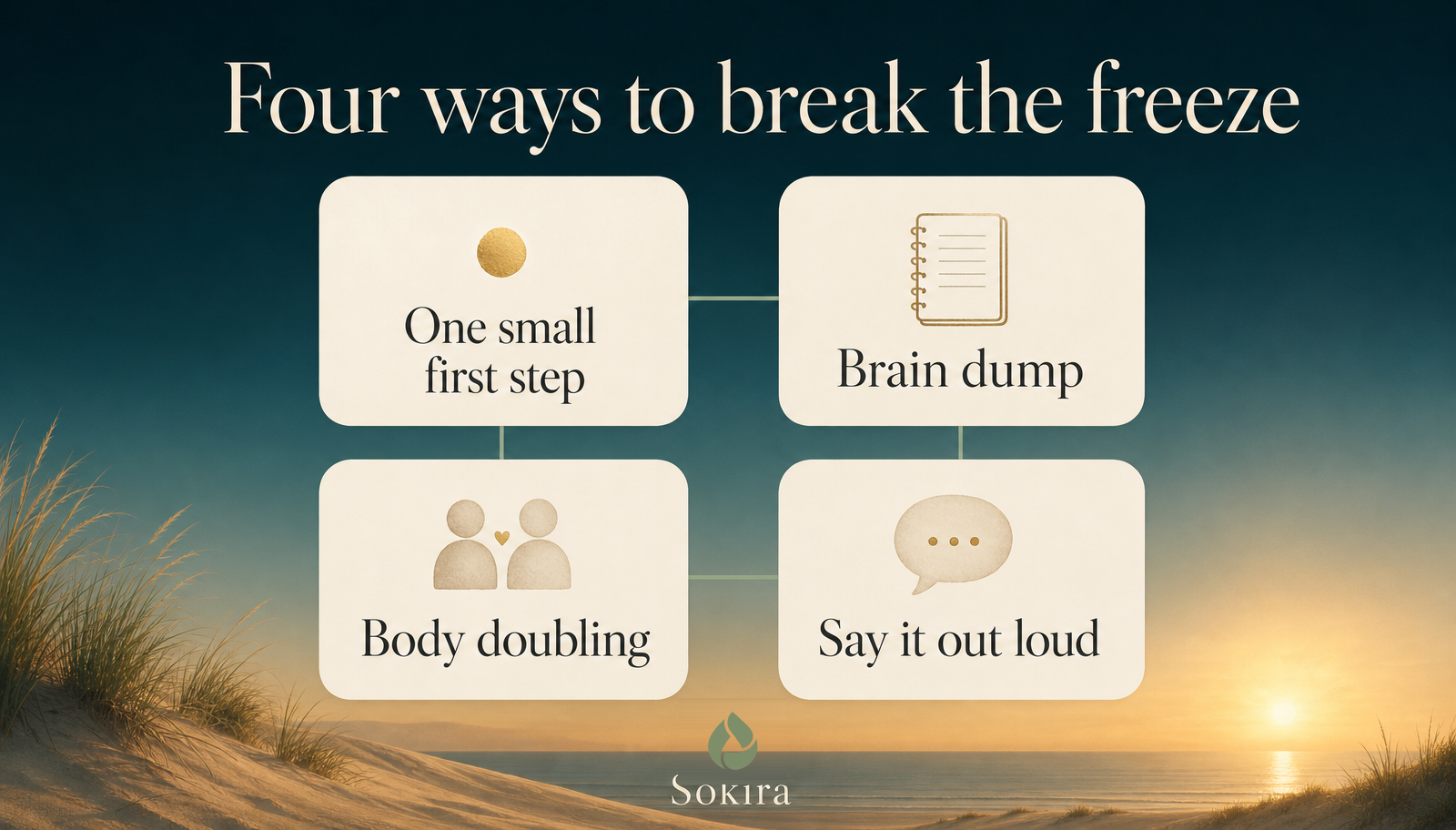
- Name one small first step. Not the plan, not the whole task. The very next physical move. There is a full walk through of this in the first-step method.
- Do a brain dump to clear the noise. Sometimes the freeze is not one task, it is fifteen half-tasks stacked on top of each other. Getting them out of your head, onto paper or into a voice memo, is often what makes the next step visible. More on this in the ADHD brain dump.
- Try body doubling. Working alongside another person, in the room or on a call, quietly lowers the friction of starting. We wrote about why this works in body doubling for ADHD.
- Say it out loud. Naming the next step aloud moves it from thinking to doing in a way a silent list rarely does. More in saying it out loud.
More in this series: ADHD Time Blindness: When "Later" Never Comes, The Five-Minute Start: Shrink the Step Until It Starts, ADHD Waiting Mode: Why a 3pm Appointment Eats the Whole Day, Self-Trust and ADHD: The Gap Between Knowing and Starting, and The Work Before the Work: ADHD's Invisible Startup Cost.
When the freeze is constant, be kind about it
Some days the stall lifts with a smaller step and a kind sentence. Some weeks it does not. If the freeze is constant, or the weight around it feels heavier than a stuck afternoon, that is worth talking about with someone who can actually help. A supportive companion is a companion, not medical care. 988 belongs to a crisis, not a stuck afternoon. Somewhere between those two is a conversation with a therapist or a doctor who knows ADHD, and that is a good conversation to have.
For the ordinary stuck afternoon, be gentle. The stall is a signal. A smaller step is a kind answer.
Where Sokira fits
There is a specific gap Sokira is built for. You know the task. You have been circling it for an hour. There is no one in the room to quietly sit with you and there is no one to say the next small step out loud to. Sokira is a voice you can talk to. It helps you break the thing down to one small first step, and stays with you while you begin. Four calm voices to choose from. First week free.
A calm voice that helps you start. Free for the first week.