 Sokira
ADHD Time Blindness: When "Later" Never Comes
Time blindness is the ADHD experience of a future that does not feel real. What it is, why "later" swallows tasks whole, and what gently helps.
In our house, “later” was a real place. Tasks went there and were never seen again.
What took me years to understand was that my son was not choosing to ignore the future. The future genuinely did not weigh anything at 4pm. An assignment due in ten days and an assignment due never had roughly the same gravity, right up until the terrifying moment they suddenly had all of it.
Jack, Sokira’s founder
What time blindness feels like from the inside
Time blindness is not a diagnosis. It is an everyday term the ADHD community coined for an experience many people with ADHD describe: the future does not feel real. You know intellectually that Thursday is coming. You can point at it on a calendar. It simply does not press on you the way it seems to press on everyone else.
So the future goes weightless. Two weeks out and two months out feel about the same, which is to say they feel like nothing much at all. And “later” goes flat. It stops being a time and becomes a room you put things in. Once something is in that room, it is not exactly forgotten. It is just no longer tugging.
Then the deadline arrives like weather. Not as a gradual approach you tracked, but as a sudden front rolling in, and now everything is urgent at once and the whole day has to bend around it. From the outside this looks like leaving things to the last minute. From the inside, the last minute was the first minute it was real.
The now and the not-now
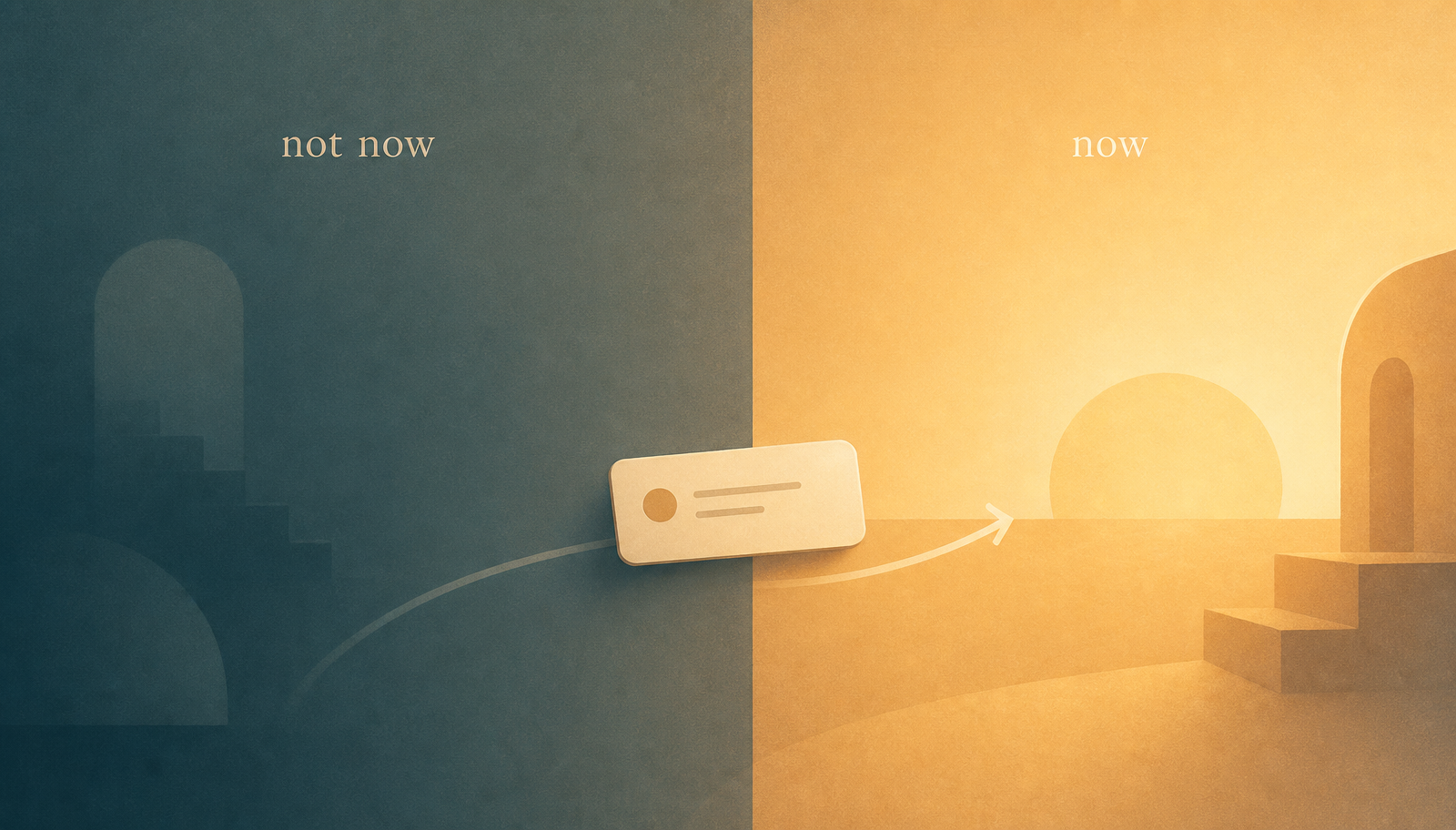
Dr. Russell Barkley describes ADHD time as sharply divided between now and not-now, with distant events exerting very little pull on present behaviour. There is not much of a gentle slope between the two. There is here, and there is everything else.
In plain words: most planning advice quietly assumes that a future consequence can reach backwards and move you today. If that reach is weak, then no amount of understanding the consequence will move you, because the understanding was never the missing part. The pull was. A task that lives in not-now does not get worked on. It gets worked on once something drags it into now.

A calm voice that helps you start. Free for the first week.
Why more calendars do not fix it
This is the part that gets people so frustrated with themselves. You buy the planner. You set the reminders. You colour code the whole week. And you still end up staring at the notification you swiped away twenty minutes ago.
A reminder is information. It tells you a thing exists and roughly when. But the problem was never information. The problem is felt weight, and a notification does not carry any. It arrives, it says the true thing, and it slides off, because the task is still sitting over in not-now and nothing about the alert moved it.
Which is why help tends to land better when it shows up at the exact moment of doing rather than in advance. We wrote about that idea in help at the point of performance.
What gently helps
None of this is a fix, and anyone selling you one is selling something. But there are a few things that tend to make a task heavier in the present, which is the only place you can act.
- Pull one task into now. Not the list, not the week. One thing, moved out of the “later” room and placed in front of you as something happening in the next few minutes.
- Say it out loud. Speaking the next action gives it a bit of physical reality that reading it never quite does, which is the whole point of saying the step out loud.
- Shrink the step until it is now-sized. If it cannot happen in the next two minutes it is still a plan, so keep cutting it down until it is small enough to be an action instead.
- Borrow someone’s presence. Another person quietly there while you begin makes the moment concrete, which is why body doubling works for so many people.
Where Sokira fits
Sokira is a voice you talk to when a task will not feel real. You say what you are avoiding out loud, it helps you cut it down to one small first step, and it stays with you while you begin. That is it. The job is not to remind you the thing exists. It is to help the thing exist now.
If the harder question for you is why you can’t start, or you want the fuller picture of task paralysis, both are worth a read. No streaks, no scores, no verdict at the end of the day.
A calm voice that helps you start. Free for the first week.