 Sokira
ADHD Waiting Mode: Why a 3pm Appointment Eats the Whole Day
One afternoon appointment and somehow nothing else happens all day. The ADHD community calls it waiting mode. What it is and what gently helps.
A 3pm dentist appointment could erase one of my son’s Saturdays. Not the appointment itself, which took forty minutes. The whole day in front of it.
From the outside it looked like doing nothing. From the inside, as he once explained it to me, the day was not empty, it was occupied. Something was already scheduled, so every other thing had nowhere to land.
Jack, Sokira’s founder
Waiting mode, from the inside
You have one thing on today. It is at three. It is not difficult, it is not far away, and it will not take long. And yet from the moment you wake up, the day belongs to it. You do not start the laundry, because what if it runs long. You do not start the piece of work you actually care about, because you would only have to stop. You check the time far more often than the situation calls for.
Then three o’clock arrives, the thing happens, it is fine, and you come home to an afternoon that feels like the wreckage of a day you never got to spend. The guilt usually lands here rather than earlier. Six hours, gone, in exchange for forty minutes.
The ADHD community calls this waiting mode, and the phrase has spread because the experience is so widely shared that people recognise it instantly. It is worth being plain about what that means: waiting mode is community language, not a clinical term. Researchers have not formally studied a condition by that name. The word is real and useful because it describes something a lot of people live with, not because it appears in a diagnostic manual.
Two honest lenses
We cannot point to research on waiting mode itself. We can point to two well-described patterns in attention that offer one way to understand it, and it is worth holding them loosely rather than treating either as a proven mechanism.
Dr. Russell Barkley has written about time in ADHD in terms of now and not now: what is happening soon carries weight, and what is distant tends not to. Most of the time that pattern works against people, and time blindness is the usual name for it. Waiting mode may be the same pattern running the other direction. A future event that has finally crossed into now has enormous weight, and it can crowd out everything standing in front of it.
Dr. Thomas Brown described attention as arriving reliably when something is genuinely interesting or genuinely urgent, and struggling when it is neither. On an appointment day, exactly one item on the list has urgency attached to it. The laundry does not. The email does not. Waiting supplies urgency to one thing and quietly drains it from everything else.
Neither of these is a diagnosis of your Tuesday. They are lenses, and the reason to reach for them at all is that they take the day out of the moral register and put it back into the practical one, which is the same shift that helps with ADHD task paralysis more broadly.
What gently helps
None of this is a cure, and anyone selling you one for waiting mode is guessing. What tends to help is smaller and less satisfying than a fix, which is usually a good sign.
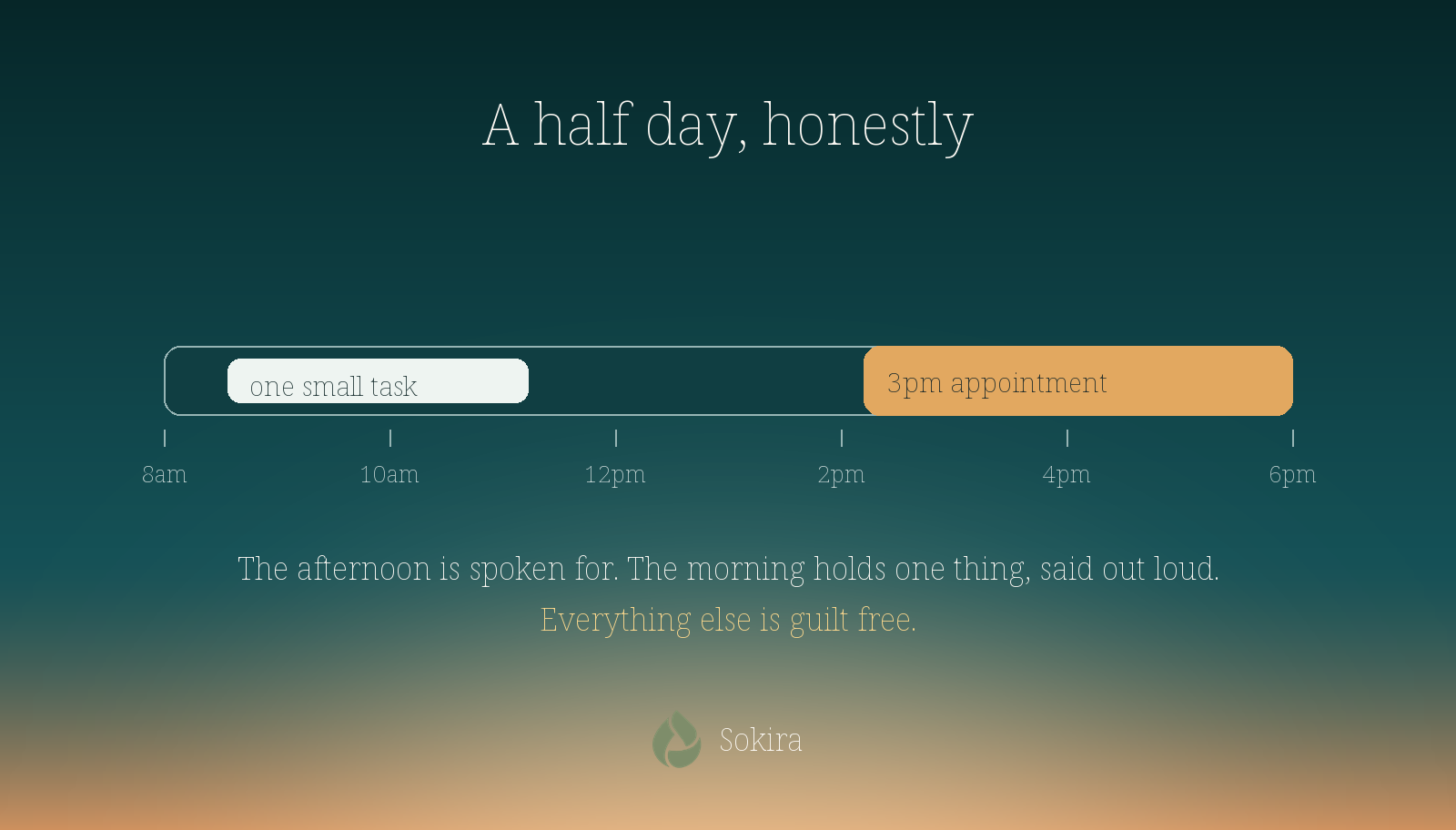
- Name the day honestly. Say it out loud in the morning: today is a half day. Not a failed full day. If you plan the morning as a morning rather than as the front of a normal Saturday, you stop measuring it against a day that was never available.
- Park one small thing in the morning. One, said out loud, and small enough that a clock cannot threaten it. Twenty minutes on something, the way the five-minute start works, is a size that survives an appointment day. A three-hour project is not.
- Put the leaving ritual where you will need it. Bag by the door, keys in the bag, address already open. The reason waiting mode grips is partly that leaving is still an unsolved problem sitting in the middle of the day. Solve it at eight in the morning, physically, in the hallway, and the afternoon has less to hold onto.
- Let the rest be guilt free. Genuinely. If the hour before you leave goes to nothing much, that hour was always going to be strange. Spending it without an argument is cheaper than spending it losing one.
Permission
A day that reorganises itself around one appointment is a scheduling style, not a moral failure. Some brains hold a future event in the foreground the entire time it is pending, and that is a real constraint, the way needing glasses is a real constraint. You can plan around it. You do not have to apologise for it, and the apology has never once made the morning go better.
Sokira is a voice you can say the morning to: one small thing before three, cut down to a first move, with something present while you begin it. Four calm voices, no scores, no streaks. First week free.

A calm voice that helps you start. Free for the first week.