 Sokira
Why self-kindness is so hard to hear
Be kinder to yourself sounds simple until you try it with ADHD. Why self-compassion can feel like an excuse, and what helps it finally land.

When my son pushed back on something we thought mattered, my wife and I learned to step back and read the room. Is this a hard day, or was he out late, or did he play football all afternoon? And then the doubt would arrive on schedule: are we being too easy on him? That question faded the more we understood ADHD.
What I did not expect was the other direction. Building Sokira meant educating myself, and I now look back on things I said to my son that I should not have said. I would have done it differently if I had known then what I know now. Gentleness was never the excuse. Not understanding was.
Jack, Sokira’s founder
The advice that bounces
Be kinder to yourself. It arrives from friends, from therapists, from the internet, from a book someone lent you. It is good advice. For a lot of adults with ADHD it also slides straight off, the way water slides off a coat.
Not because they disagree with it. Most people nod. The trouble starts a second later, when they try to actually do it and something inside refuses. It feels unearned, given the pile of things still undone. It feels unsafe, as though the only thing keeping the whole arrangement upright is the pressure. Or it simply feels fake, like reading a line off a card in someone else’s handwriting.
That is not weakness and it is not resistance to help. It is worth knowing why it happens, because the reasons turn out to be quite specific.
What researchers heard when they actually asked
An Australian team interviewed university students with ADHD about self-compassion and published what they found in the journal Emerging Adulthood. Rather than measuring anything, they asked adults to describe what got in the way. Three things came back.
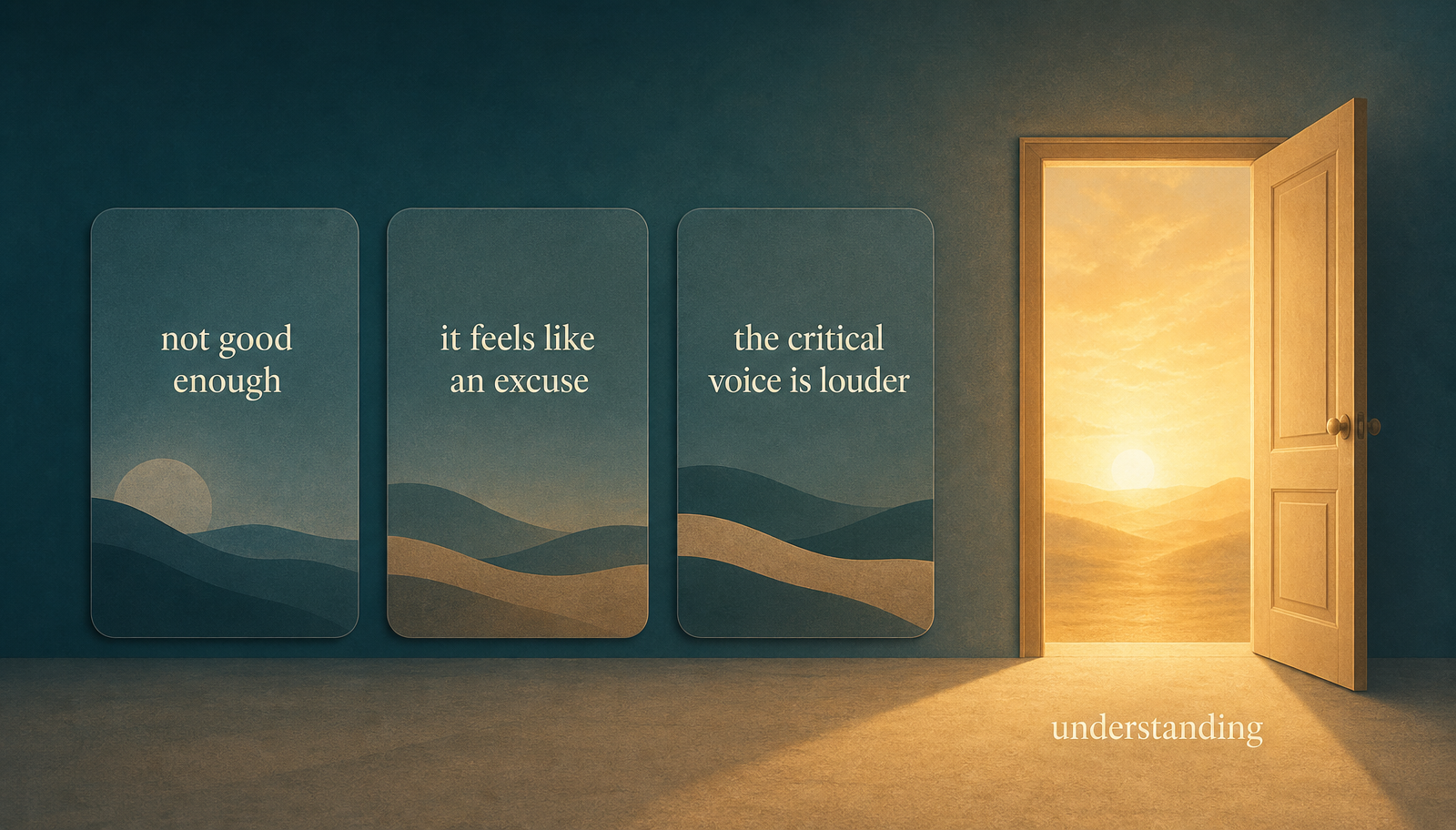
The first was a chronic sense of not being good enough. When you have spent years falling short of what you intended, kindness starts to look like something other people qualify for. The second was a debt. There is a backlog of effort owed, and until it is paid, kindness reads as letting yourself off the hook. The third was the plainest of all: kindness is genuinely difficult to generate when the voice already running is a critical one.
“I keep thinking I'm letting myself off, what if it's an excuse?”
Another student, whom the researchers call Soraya, described the wider problem: the traits are treated by the world as “flaws that in this world don’t deserve compassion”. If everything around you has agreed that these are failings rather than differences, offering yourself compassion feels like breaking a rule that everyone else is still following.
The line that explains everything
“you're so used to self-criticism, you don't really know what self-kindness actually sounds like”
Read that again slowly. It is not that kindness has been rejected. It is that it has never been heard, so there is no model of it to copy. You cannot speak in a tone you have not listened to.
And here is the piece that gets lost in the be kinder advice. Kindness is not a lowered bar. It is not a decision to expect less of yourself. The researchers put the mechanics plainly: “the very nature of self-regulation difficulties is that they are hard to overcome through effort alone”. If that is true, then treating every miss as a character failure is not high standards, it is a wrong explanation applied over and over. Gentleness is not an excuse. It is accuracy about how effort works.
What actually helped
The same study asked the other question too, and the answer was not trying harder at kindness. Nobody described succeeding by pushing themselves toward warmth the way they had pushed themselves toward everything else.
The one thing the students named was understanding and acceptance. Understanding from other people, and understanding of themselves. When the difficulty has a real explanation, kindness stops feeling like a lie you are telling to get out of something. It becomes the reasonable response to an accurate account.
That is also why where the critic comes from matters so much. A voice you can trace is a voice you can eventually argue with, and the inner critic usually turns out to be quoting other people. The short version of all of it sits in you’re not lazy, and it belongs to our wider writing on ADHD in women.
Hearing it out loud
If the kind voice does not exist inside yet, it can be borrowed while it grows. That is not a trick. It is how most people learned every tone they have.
A patient friend who asks how it went without flinching at the answer. A group of people who recognise the problem before you finish describing it. Even the simple act of saying it out loud moves something from a swirl into a sentence, and sentences are easier to be reasonable about than swirls.
Where Sokira sits
Sokira is a calm voice you talk to when starting is hard. It responds to an unfinished day without a single note of scolding, because there is nothing to score and no record of misses being kept. The absence of guilt is the whole design, not a feature. If a kind voice is something you have not heard much of, it can help to hear one.

A calm voice that helps you start. Free for the first week.