 Sokira
What I read this week, August 20
Every week I pick a few things worth your time on ADHD, and skip the rest. No hacks, no hype.
Twelve women, diagnosed in midlife, finally handed the right map
Journal of Attention Disorders
A new qualitative study, first published online in late July, sat down with twelve women aged 45 to 58 who were diagnosed with ADHD as adults. The themes will be familiar to anyone who has read the community forums: years of misdiagnosis, criticism slowly turned inward, and emotional weather made rougher by hormonal shifts that also complicated treatment. Then the turn: the women described the diagnosis as profoundly validating, and many reframed their hyperfocus as a strength that had quietly carried them for decades. The study title uses the word superpower, and regular readers know I am wary of that framing. We wrote about why the advantage story overpromises. But there is a difference between a marketer selling ADHD as a gift and a woman in her fifties deciding, with the right map finally in her hands, which parts of her brain she is proud of. The first is a pitch. The second is hers.
Stress alone does not write the story. The support around a child helps decide it
PsyPost
A Seoul National University team followed thousands of children from the large ABCD study across two years, asking why some children develop ADHD symptoms after stressful life events while others do not. Stressful experiences were linked to more symptoms overall, but the vulnerability was not evenly spread. What separated the children who struggled most from those who proved more resilient was the context around them: parental mental health, family genetic risk, and how the brain networks for planning and self-control were developing. The researchers point to family support, early assistance, and care for parents themselves as parts of prevention. It is the same lesson the long-term outcome research keeps teaching: the average is not the person, and the scaffolding around a person is not decoration. It is load-bearing.
The clearest plain-English tour of task paralysis I have found
NeuroSpark Health
This one is an explainer rather than news, updated in May, and it earns its place. A neurodivergent therapist walks through task paralysis, the freeze where you want to act and cannot, and treats it as what it is: executive function under overwhelm, not laziness. The tour covers burnout, hard transitions, uncertainty, and the shame spiral that makes all of it worse. What I appreciated most is where the advice lands. Start smaller than you think you need to. Let another person be present while you begin. Trade self-pressure for self-compassion, because the criticism is part of the freeze, not the cure for it. If that sounds close to word for word like the bet behind Sokira, that is exactly why it is here.
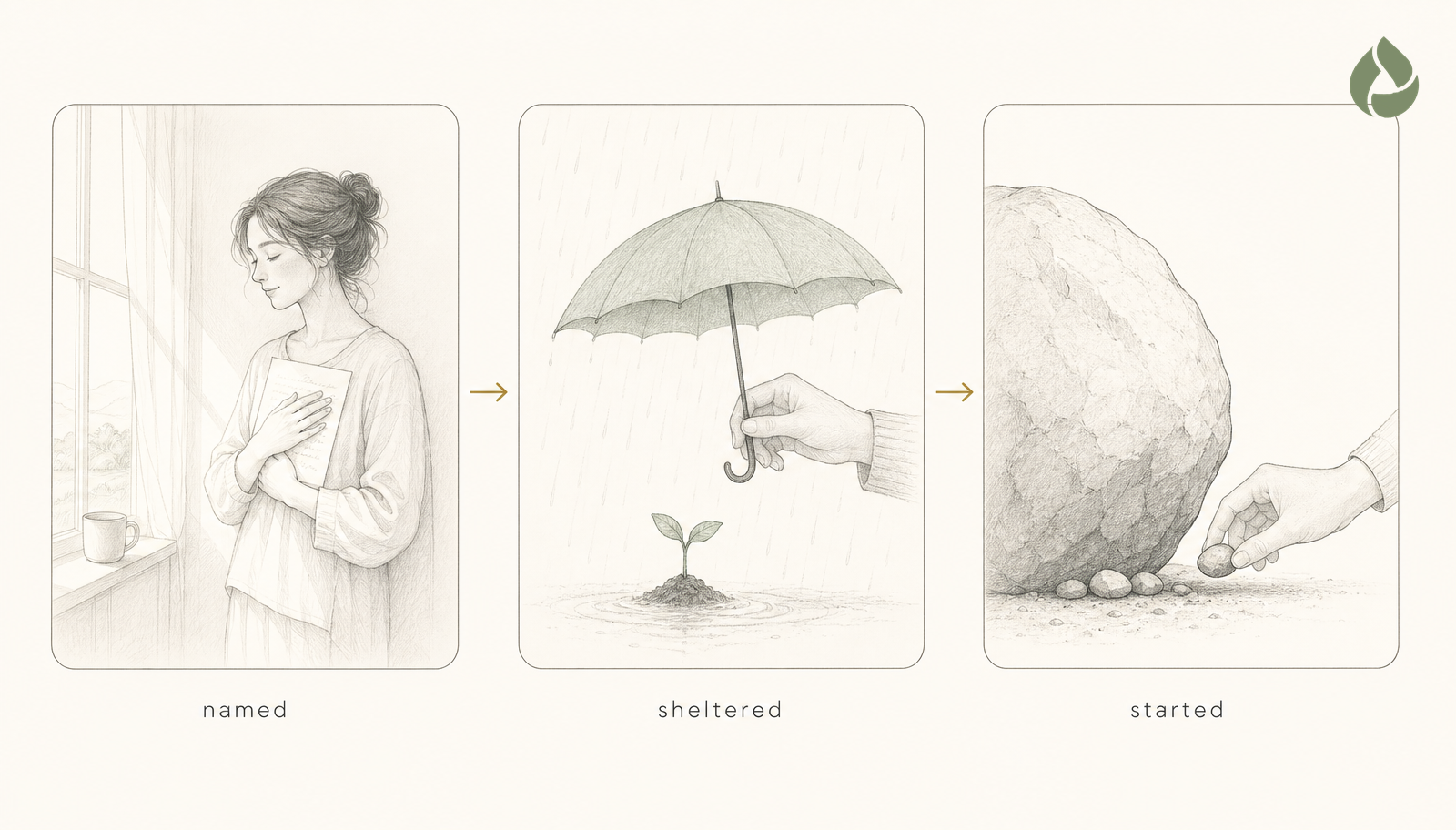
One thing I keep thinking about. These three pieces describe the same shape from three different distances. A diagnosis in midlife is support arriving decades late, and still changing everything. The stress research says the support around a child helps decide how hard life events land. And the task paralysis explainer names where support belongs in the smallest moment: right at the first step, shrunk down until it is startable, with someone present. Support is not the bonus feature of a life with ADHD. It is the variable. That is the whole bet behind Sokira: a calm voice that is there at the exact moment starting is hardest, helps you say the next small step out loud, and stays with you while you begin.
No streaks. No scores. No guilt.
Jack
Founder, Sokira

A calm voice that helps you start. Free for the first week.